Welcome, Guest

Sign in to learn, create, and do more with the product you love.

News & Updates

Filters:
Tag
6-Layer PCB Design
Blog
6-Layer PCB Design Guidelines

Once you’ve run out of room on your 4-layer PCB, it’s time to graduate to a 6-layer board. The additional layer can give you room for more signals, an additional plane pair, or a mix of conductors. How you use these extra layers is less important than how you arrange them in the PCB stackup, as well as how you route on a 6-layer PCB. If you’ve never used a 6-layer board before, or you’ve had EMI troubles with this stackup that are difficult to solve, keep reading to see some 6-layer PCB design guidelines and best practices.

Component Management
On-Demand Webinar
Help Ensure The Best Designs With Component Management

There are many aspects to designing a PCB. One of the larger aspects has to do with managing your components. We all need components for our designs, but are those components in our library and designs up-to-date or even purchasable? These questions need to be answered before we can safely use them. If not, we could just be wasting our time designing with invalid components. Altium Designer® has several tools to help you manage the components in your libraries and designs.

Altium Designer Interface
Blog
Altium Designer 22.5 Update

We are happy to announce that the Altium Designer 22.5 update is now available. Altium Designer 22.5 continues to focus on improving the user experience, as well as performance and stability of the software, based on feedback from our users. Check out the key new features in the What's New section on the left side of this window!

Are Hybrid PCB Stackups Reliable?
Blog
How Reliable is Your Hybrid PCB Stackup?

PCB stackups often incorporate slightly dissimilar materials that could pose a reliability problem. Hybrid PCBs are one case where the PCB stackup will include different materials, typically a standard FR4 laminate and a PTFE laminate for RF PCBs. Designers who want to take the lead on material selection when designing their hybrid stackups should consider these factors that affect reliability. As with any PCB stackup, make sure you get your fabricator involved in the manufacturing process early to ensure reliability problems do not arise during production.

Embedded thumbnail for How to Draw a Board Outline Using Coordinates
How-To's
How to Draw a Board Outline Using Coordinates

In this video, we cover how to draw a curve by using coordinates. This can be very helpful when creating a board outline.

Embedded thumbnail for Creating a Schematic Symbol: Mapping out the Component
How to create a Schematic Symbol
Creating a Schematic Symbol: Mapping out the Component

When creating a schematic symbol, one of your first tasks will be creating a component symbol. We’ll show you how to map out a component in the Schematic Library Editor by creating and configuring the component, adding pins, and creating graphics.

Monte Carlo vs Sensitivity Analysis
Blog
Monte Carlo Simulation vs. Sensitivity Analysis: What’s the Difference?

In a previous article about circuit simulation and reliability, I looked at how Monte Carlo analysis is commonly used to evaluate circuits that are subject to random variations in component values. Sensitivity analysis is a bit different and it tells you how the operating characteristics of your circuit change in a specific direction. Compared to a Monte Carlo simulation, sensitivity analysis gives you a convenient way to predict exactly how the operating characteristics will change if you were to deliberately increase or decrease the value of a component.

Embedded thumbnail for How and When to Use Rooms
How to work with Rooms
How and When to Use Rooms

Rooms are an extremely valuable tool within the Altium Designer PCB environment, but how and when do you use rooms? If you need to control component placement and layout, assign a specific design rule to a group of items, or if you have repeated channels that need similar layouts in your multichannel design, rooms can make it much easier.

Simulation, Build and Test
Blog
Creating Continuous Integration Pipelines for FPGAs

Field Programmable Gate Arrays, or FPGAs, have become ubiquitous amongst high-speed, real-time digital systems. The speed at which FPGAs operate continues to increase at a dizzying pace but their adoption into Continuous Integration pipelines seems not to trail as closely. In this article we will review the concept of CI pipelines, their application to FPGAs, and look at examples on how to set this up.

Embedded thumbnail for MCAD CoDesigner Quick Start: Autodesk Fusion 360
Working with MCAD CoDesigner extension
MCAD CoDesigner Quick Start: Autodesk Fusion 360

MCAD CoDesigner is built to address the challenges of electronic product design by enabling seamless collaboration between your electrical and mechanical engineers. This video will show you how to start collaborate between Altium Designer and Autodesk Fusion 360. 

Embedded thumbnail for Component Placement Control for DFM
DFM and Fabrication Cost/Time Constraints
Component Placement Control for DFM

Component placement is a crucial part of making sure your design is manufacturable, so you need to be able to control placement. We’ll show you how, through rules and courtyard layers to maintain accessibility and manufacturability in your entire design through component placement control.

Collaborators Visualization
Blog
Soft Locks [Conflict Prevention] in Altium 365

Conflicts can occur when multiple people work on the same project simultaneously. The user might not realize that they are not looking at the latest version of the documentation, leading to problems later. To address this issue, Altium features an intuitive graphical user interface that allows you to examine conflicts quickly and carefully

Component Creation
On-Demand Webinar
Increase Productivity With Easy Component Creation

Component creation is a necessary evil when it comes to design, and it’s something we all need to do. But instead of spending hours creating your components and having them turn into a complete roadblock, let it be just a simple bump on the road. Altium Designer has several tools available to you in order to create the different aspects of a component, including the symbol, footprint, 3D model parametric data, supply chain information, and more

Guide to Monte Carlo in SPICE
Blog
The Basics of Monte Carlo in SPICE: Theory and Demo

Anytime you place a component in your PCB, it’s almost like you’re gambling. All components have tolerances, and some of these are very precise, but others components can have very wide tolerances on their nominal values. In the event the tolerances on these components become too large, how can you predict how these tolerances will affect your circuits?

Embedded thumbnail for MCAD CoDesigner Quick Start: PTC Creo
Working with MCAD CoDesigner extension
MCAD CoDesigner Quick Start: PTC Creo

MCAD CoDesigner is built to address the challenges of electronic product design by enabling seamless collaboration between your electrical and mechanical engineers. This video will show you how to start collaborate between Altium Designer and PTC Creo

Embedded thumbnail for Variants in Multi-Channel Designs
How to work with Variants
Variants in Multi-Channel Designs

Multi-channel designs can utilize variations in the channels to reduce design time and sheet count. We’ll show you how to take advantage of this by configuring several types of components.

BGA Land Patterns and Footprints
Blog
What's In Your BGA Land Pattern and Footprint

If you look in datasheets for most components, you’ll often find a recommended land pattern, usually alongside some mechanical package information and assembly information. This is not always the case with BGA components, especially components with high ball count. There are a few reasons for this that we can speculate: those ball counts might just be too big to put into a single page, or the manufacturer just expects you to know how to create that land pattern.

Embedded thumbnail for Stackup Considerations
DFM and Fabrication Cost/Time Constraints
Stackup Considerations

There is a lot to consider about the Layer Stackup when it comes to designing a manufacturable board. We’ll walk you through enabling symmetry, finding correct balance of your layers, materials, creating and loading templates, and adding a layer stack table for better communication between you and your manufacturer.

Molded Interconnect Devices
Blog
MIDs Make a Comeback as Vertical SMD Modules for Your PCB

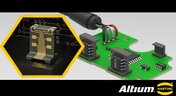
Molded interconnect devices are essentially plastic molded substrates with traces running along any surface, including at right angles and running vertically. Altium users can use the new 3D Routing extension to design their own component carriers, which can be mounted vertically in a standard assembly process. If you’ve always wanted to vertically mount components or entire circuits, but without the expense of adding a flex section to your design, the new 3D Routing extension with HARTING’s component carrier designs provides a unique solution.

Embedded thumbnail for What Are Design Variants For?
How to work with Variants
What Are Design Variants For?

Variants in Altium Designer allow you to create several variations of the same design all from one source project. Variants can be managed in the project and through Altium Designer you can control variants in the PCB, Schematic, Draftsman, and Outjob files to make your designs easily editable without redundancy.

Tag
Schematic
Blog
Altium Designer 22.10 Update

We are happy to announce that the Altium Designer 22.10 update is now available. Altium Designer 22.10 continues to focus on improving the user experience, as well as performance and stability of the software, based on feedback from our users. Check out the key new features in the What's New section on the left side of this window!

Component Warpage Causes in a PCB
Blog
Component Warpage Causes in a PCB

A staff member at a PCB manufacturer once explained to me that they thought we were having an issue with a package warping. Unfortunately, component warping can occur both in a PCB and in components. In this article, we'll give an overview of warpage in a PCB, specifically in the circuit board and in the components.

Link Budget Calculator
Blog
RF Signal Chain and Link Budget Basics

If you're designing a wireless IoT device, and you know how to calculate the link budget, you can reasonably estimate whether your signal will reach its destination and be read by the receiver. To calculate the link budget, the designer needs to know something about all other sources of gain and loss in the system. Once link budget is determined, the designer can judge whether some modification is needed in their RF signal chain. 

How to Calculate SMD Pad Sizes?
Blog
Best Methods for Calculating SMD Pad Size in PCB Design

SMD components require precisely sized pads for soldering during assembly. The designer is responsible for ensuring pad sizes are correct, either by calculating them and comparing with footprint data, looking through datasheets, or by memorizing SMD pad size standards. If you have a component and you don't have access to the footprint, and you decide to biuld the footprint yourself, what resources are available to ensure you have the correct pad size?

Can You Fix a Warped PCB?
Blog
Can You Fix a Warped PCB?

Before we get too deep into this article, I’ll give you the simple answer. You probably can’t fix warping in your PCB after it’s already been fabricated. You can prevent an unwarped board from becoming warped during assembly, but only as long as materials were selected properly and the board is put into reflow correctly. We’ll run over some of these points in this article, and I’ll examine some points that might help you recover a warped board.

What is an Eye Diagram?
Blog
What is an Eye Diagram?

The eye diagram is a useful measurement or simulation as part of channel compliance. The measurement shows many different factors that can affect signal behavior simultaneously, ultimately allowing for qualification of errors and losses in a channel. In this article, I’ll run over some of the fundamental measurements that you could manually extract from an eye diagram and how they reveal some strategies for improving channel designs.

Skills for Today's PCB Designers
Blog
What Skills Are Needed to be a PCB Layout Designer?

To readers who have been working in the PCB industry for most of your career, you have probably seen a very diverse group of professionals with varied skill sets and backgrounds. Designers might get started as engineers or as technicians, and some designers learn how to create beautiful PCB layouts in university. No matter how you got into PCB design, there are some important skills to know that will take you a long way towards advancing your career.

How to Fix the Top PCB Design Mistakes
Blog
Beginner PCB Design Mistakes and How To Avoid Them

When starting out with PCB design, it’s common to treat the process as simply ‘connecting the dots’: as long as connections are made, it’s not particularly important how these connections are made. Having reviewed quite a number of PCBs of other PCB design engineers over the last few years, there are common, unfortunately erroneous, occurrences between a lot of them. This article aims to illustrate the top five beginner PCB design mistakes and what we can do to avoid making them. Let’s get started!

Top 5 Questions Regarding Stack Up
Blog
SAP (Semi-Additive PCB Process) – Top 5 Questions Regarding Stack Up

As the PCB design community embraces the benefits of this new printed circuit board fabrication technique, there are of course many questions to be answered.  Today’s blog will address some of the most commonly asked questions related to circuit layer stack up as people are introduced to this new technology.

Design Reuse Blocks Update
Blog
Altium Designer 22.9 Update

We are happy to announce that the Altium Designer 22.9 update is now available. Altium Designer 22.9 continues to focus on improving the user experience, as well as performance and stability of the software, based on feedback from our users. Check out the key new features in the What's New section on the left side of this window!

Dual Rail Voltage Supply
Blog
Dual Rail Voltage Supply

The highest performing operational amplifiers often need a split supply with positive and negative voltages connected to the op amps supply rails. In this project, we’re going to be building a positive/negative dual rail power supply for a differential oscilloscope probe I’m designing. I’m making the power supply a separate project, as a dual rail supply is quite useful to have, and I’m sure I’ll find multiple uses for it in the future.

Library Importer Interface
Blog
Library Importer Improvements (former Library Migrator)

Importing file-based libraries from your local computer or network drive to your Altium 365 workspace can be done using the Library Importer. Altium’s Library Migrator was renamed Library Importer—the feature’s name was changed to conform more closely to the tool’s purpose. Not only is its name new, but our team has also made several user experience improvements. We have updated the documentation to reflect this change.

Blog
How to Select Copper Foil for High-Frequency PCB Design

The PCB materials industry has spent significant amounts of time developing materials that provide lowest possible signal loss for products with RF applications. For high speed and high frequency designs, losses will limit signal propagation distance and distort signals, and it will create an impedance deviation that can be seen in TDR measurements. In this article, we'll look at the balance between copper foil losses and other types of losses in a PCB, as well as some strategies that are commonly used to overcome roughness.

Blog
Altium Designer 22.8 Update

We are happy to announce that the Altium Designer 22.8 update is now available. Altium Designer 22.8 continues to focus on improving the user experience, as well as performance and stability of the software, based on feedback from our users. Check out the key new features in the What's New section on the left side of this window!

What is Hybrid Beamforming?
Blog
What is Hybrid Beamforming?

In this article, we’ll look at beamforming implementation in an advanced method combining analog and digital techniques, known as hybrid beamforming. This method blends both digital and analog techniques to create multiple beams and thus reach multiple users with varying intensities. In the case of an RF imaging system or a radar system, hybrid beamforming in a MIMO technique also allows tracking of multiple targets with adjustable resolution.
Is your via impedance calculator accurate?
Blog
Why Most Via Impedance Calculators Are Inaccurate

The problem with every via impedance calculator that I have seen is simple: they are incomplete or totally wrong. The “incomplete” part refers to a lack of context; these calculators can roughly reproduce a well-known estimate from a legend like Howard Johnson in his Digital Design textbooks. However, these calculators never provide insight into what they are actually calculating, or where the calculated via impedance is accurate. Keep reading to see why these calculators get it so wrong, as well as the context surrounding via impedance.

Tag
Embedded thumbnail for Working with Dimensions: Draftsman Documents
How to Work with Draftsman
Working with Dimensions: Draftsman Documents

Draftsman Documents provide dimensioning tools to capture and display the physical features of the product for fabrication and documentation. 

Embedded thumbnail for Impedance Calculations: Differential Pairs
Impedance calculation
Impedance Calculations: Differential Pairs

Altium designer makes it easy to calculate geometry when you need to calculate impedance for differential pairs. We’ll go over how differential pairs can help with a two layer and multi layer board, as well as what types you can create such as differential co-planar, and how to configure them for your specific design.

Embedded thumbnail for Creating and using templates
How to Work with Draftsman
Creating and using templates

Draftsman Templates are a quick way of laying out your Draftsman Document in Altium Designer. We’ll show you how to utilize them and the differences between sheet and document templates.

Embedded thumbnail for Adding 3D Assemblies to a Multi-Board Project
How to work with Multiboard
Adding 3D Assemblies to a Multi-Board Project

The next step in the multiboard design process is adding 3D PCB Assemblies. We’ll show you how to add them to your design and how to work with the Assembly Editor.

Embedded thumbnail for Altium 365 - Design Collaboration | Tasks
Getting Started with A365
Altium 365 - Design Collaboration | Tasks

The Tasks feature brings lightweight task tracking to further enhance design collaboration in Altium 365. With Tasks, you will never lose an important action item and easily gain a high-level view of the state of your project, all without leaving your design environment. 

Embedded thumbnail for Adding Additional Views in a Draftsman Document
How to Work with Draftsman
Adding Additional Views in a Draftsman Document

If you need additional views in your documentation, Altium Designer’s Draftsman Document editor can help. We’ll show you how to add and configure different views including the component view, the section view, the detail view, the isometric view, variants, the legend for the layer stack, the board region view, and the board realistic view.

Embedded thumbnail for Draftsman Document Views - Fabrication and Drill Drawings
How to Work with Draftsman
Draftsman Document Views - Fabrication and Drill Drawings

The Draftsman Document Editor allows you to add a fabrication view and a drill drawing view to your outjob files. We’ll show you how to get them set up and details you can control from the properties panel.

Embedded thumbnail for Altium 365 - Version Control | Project History
Getting Started with A365
Altium 365 - Version Control | Project History

Project History in a Nutshell: - Presents events in a chronological timeline (Creation, Commits, Releases, Clones, and MCAD Exchanges) - Auto-generates Differences Summary to view the differing entities (e.g., replaced components) - Even a non-expert can act on a revision (Download, View, Revert)

Embedded thumbnail for Resolving Conflicts in Multi-board Schematics
How to work with Multiboard
Resolving Conflicts in Multi-board Schematics

When mismatched pin names in your multi-board schematic cause disconnects and conflicts you can use Altium Designer’s tools to resolve these conflicts. We’ll show you the Connection Manager and the various solutions to solve your connection issues.

Embedded thumbnail for Draftsman Document Board Assembly View
How to Work with Draftsman
Draftsman Document Board Assembly View

The Draftsman Document can include a Board Assembly View. We’ll show you how to add it and the properties you can change to create the exact view or views you need.

Embedded thumbnail for Placing Connections Between Boards
How to work with Multiboard
Placing Connections Between Boards

A multi-board design requires relationships between several board designs referred to as interboard connections. We’ll show you the different types of connections and how to connect your boards using the proper connection type.

Embedded thumbnail for Show the Net Connections Between Select Components
How-To's
Show the Net Connections Between Select Components

This video demonstrates how to show net-specific component connections. This is helpful when routing as you’re able to reduce clutter and focus on the connections on which you are working.

Embedded thumbnail for Draftsman Editor Settings
How to Work with Draftsman
Draftsman Editor Settings

In this video we’ll go over the Draftsman editor settings and properties so you know how to set up the editor to be exactly what you need.

Embedded thumbnail for Assuring Your Board Is Large Enough to House All Components
How-To's
Assuring Your Board Is Large Enough to House All Components

This video covers how to make sure your board is big enough to house all your components.

Embedded thumbnail for How to Create an Interactive PDF of a Schematic Diagram
How-To's
How to Create an Interactive PDF of a Schematic Diagram

This video shows how to create an interactive PDF using the Smart PDF Wizard.

Embedded thumbnail for What is the Draftsman Document?
How to Work with Draftsman
What is the Draftsman Document?

Once your PCB layout is finished it’s time for review. This is where the Draftsman Document and Altium Designer’s Draftsman Editor comes in.

Tag
Your search returns no results.