Welcome, Guest

Sign in to learn, create, and do more with the product you love.

News & Updates

Filters:
Tag
Embedded thumbnail for Bottom Terminated Component Guide: Footprint Design Best Practices
How-To's
Bottom Terminated Component Guide: Footprint Design Best Practices

Want to create a reliable footprint for your PCB design? Watch our latest video with Zach Peterson and learn best practices for designing PCB footprints for bottom-terminated components. This tutorial covers how to properly design paste masks for QFNs, BGAs, and other bottom-terminated packages to prevent common assembly issues.

Embedded thumbnail for Design 4x Faster with Altium Designer 25
Altium Designer's 25 Quantitative Benefits
Design 4x Faster with Altium Designer 25

PCB CoDesign in Altium Designer 25 enables multiple engineers to collaborate on a single PCB design, saving over 10 minutes and 300+ clicks. With an intuitive compare-and-merge workflow, teams can efficiently resolve conflicts and streamline their design process. Check out this video to learn more, and use the Benefit Calculator to see your potential time savings: https://www.altium.com/benefit-calculator.

Blog
Ultra HDI: It’s Not Just Buzzword

Ultra-HDI technology is transforming PCB design, enabling unprecedented miniaturization and performance. In this article, explore what sets Ultra-HDI apart from traditional HDI and how it’s shaping the future of electronics.


Embedded thumbnail for Empowering Hybrid Designs with Wire Bonding
New in Altium Designer 25
Empowering Hybrid Designs with Wire Bonding

Our latest whitepaper on Wire Bonding technology is now available! It explores the role of wire bonding in modern PCB design and how Altium Designer 25 enhances the process with dedicated features. Access it here: Wire Bonding Whitepaper.

Blog
Cloud PCB Design: 5 Cloud Security Myths Debunked

This article addresses common misconceptions about cloud security in PCB design. It explains how modern cloud platforms, such as Altium 365, often provide superior security compared to traditional on-premises solutions. Key features like advanced infrastructure, granular access controls, and compliance with stringent regulations ensure the protection of valuable design data.

Embedded thumbnail for 8 Times Faster Simulations Using Altium Designer 25
Altium Designer's 25 Quantitative Benefits
8 Times Faster Simulations Using Altium Designer 25

Speed up your simulations with Altium Designer 25—now up to 8x faster! Watch our comparison to see how built-in simulation slashes processing time, saving you valuable minutes on every task.

Embedded thumbnail for Harness Design Top 5 Improvements in Altium Designer 25
New in Altium Designer 25
Harness Design Top 5 Improvements in Altium Designer 25

Harness Design in Altium Designer 25 just got a major upgrade! This video showcases the top five new features that improve flexibility, organization, and efficiency in your wiring workflow. Watch now to see these enhancements in action and take your designs to the next level!

Blog
Renesas and Altium Announce Introduction of Renesas 365, Powered by Altium

Last week, Renesas Electronics and Altium proudly announced the introduction of Renesas 365, Powered by Altium—a first-of-its-kind industry solution designed to streamline electronic system development, from silicon selection to system lifecycle management. Renesas 365 will be demonstrated at Embedded World, Booth 5-371, from March 11-13 in Nuremberg, Germany.

Embedded thumbnail for HitIQ uses Altium solutions to better understand brain injuries in sports sciences
Altium Stories
HitIQ uses Altium solutions to better understand brain injuries in sports sciences

Watch our video about HitIQ and theirs usage of Altium's software to develop a Smart Mouthguard, an advanced concussion management solution. Our software accelerated their development, improved accuracy, and its helpful for detecting and managing sports-related brain injuries.

Blog
DFM/DFA Requirements in Systems Engineering

Learn how integrating DFM and DFA principles into systems engineering ensures manufacturable, cost-effective PCB designs by optimizing CAD, CAM, and requirements management in our new article by Javier Alcina.

Embedded thumbnail for Boost Team Productivity with Seamless Collaboration - Recording Preview
New in Altium Designer 25
Boost Team Productivity with Seamless Collaboration - Recording Preview

Discover how to enhance your PCB design workflow with Altium Designer and Altium 365. Learn to speed up tasks, enhance collaboration, connect teams, and optimize part selection—all in one seamless environment.

Blog
Best Practices for Electronics Project Management - Part 2

Part 2 of this series covers essential project management techniques for electronics design teams. Rafał Stępień discusses effective data organization, revision control, and collaboration strategies to improve efficiency and minimize errors.

Embedded thumbnail for Altium Tutorial: Harness Design to Multi-Board Assembly Workflow
How-To's
Altium Tutorial: Harness Design to Multi-Board Assembly Workflow

Watch our latest tutorial on Harness Design and Multi-board, where we showcase best practices for Harness Design, MCAD collaboration, and manufacturing documentation generation to enhance your PCB assembly workflow.

Blog
Rigid-Flex PCBs: Understanding the Pros, Cons, and Fabrication Considerations

Read our new article which discusses the advantages of rigid-flex PCBs, such as space-saving designs and enhanced reliability, while also addressing potential challenges in their fabrication. It provides essential design and manufacturing tips to help engineers effectively implement this technology in various applications.


Embedded thumbnail for Smart Mouthguard Impacting Concussion Science
Altium Stories
Smart Mouthguard Impacting Concussion Science

Check out our latest Customer Success Story about HitIQ, founded by former AFL player Nathan Murphy. HitIQ harnessed Altium’s design and collaboration tools to develop its Smart Mouthguard—an advanced concussion management solution. The team utilized Altium Designer’s Rigid-Flex PCB capabilities and Constraint Manager, along with Altium 365’s Web Viewer and Cloud Storage, to create a compact yet highly functional design while enhancing cross-functional collaboration.

Blog
The Role of Automation & Robotics in Wire Harness Assembly

Our new article highlights how automation and robotics are transforming wire harness assembly, improving efficiency, precision, and cost-effectiveness. Technologies like robotic wire handling and AI-driven testing are paving the way for smarter production. However, challenges like custom designs and high costs still persist.
Embedded thumbnail for The Hidden Dangers of PCB File Sharing (And the One Solution You Need)
How-To's
The Hidden Dangers of PCB File Sharing (And the One Solution You Need)

Protect your PCB designs from security risks! This video uncovers hidden vulnerabilities in traditional file-sharing methods and shows how encrypted file transfers can safeguard your intellectual property. Learn why email and unsecured cloud storage aren’t enough—and explore secure collaboration solutions used by leading companies.

Embedded thumbnail for Optimized for Success: Advanced PCB Features in Altium Designer - Recording Preview
New in Altium Designer 25
Optimized for Success: Advanced PCB Features in Altium Designer - Recording Preview

Unlock the power of Altium Designer 25 to streamline your PCB design process. With advanced features like dynamic phase matching and enhanced signal integrity tools, you’ll improve efficiency and reduce errors. Watch the webinar recording now to see how this release can elevate your design workflow!

Tag
RF PCB
Blog
RF Power Supply Design and Layout Guide

One thing is certain: power supply designs can get much more complex than simply routing DC power lines to your components. RF power supply designs require special care to ensure they will function without transferring excessive noise between portions of the system, something that is made more difficult due to the high power levels involved. In addition to careful layout, circuitry needs to be designed such that the system provides highly efficient power conversion and delivery to each subsection of the system.

Prevent Overvoltage, Overcurrent and Heat logo
Blog
Methods to Protect your Circuit

Overvoltage, overcurrent, and heat are the three most likely events that can destroy our expensive silicon-based components or reduce our product’s life expectancy. The effects are often quite instant, but our product might survive several months of chronic overstress before giving up the ghost in some cases. Without adequate protection, our circuit can be vulnerable to damage, so what should we do? Or do we need to do anything?

SUBCKT sharing
Blog
SUBCKT Sharing: The Fastest Ways to Share SPICE Models Online

Today’s PCB designers and layout engineers often need to put on their simulation hat to learn more about the products they build. When you need to perform simulations, you need models for components, and simulation models often need to be shared with other team members at the project level or component level. What’s the best way for Altium Designer users to share this data? Read this article to learn more about sharing your models with other design participants. 

RF Printed Circuit Board
Blog
RF PCB Material Comparison for mmWave Devices

When some designers start talking materials, they probably default to FR4 laminates. The reality is there are many FR4 materials, each with relatively similar structure and a range of material property values. Designs on FR4 are quite different from those encountered at the low GHz range and mmWave frequencies. So what exactly changes at high frequencies, and what makes these materials different? To see just what makes a specific laminate useful as an RF PCB material, take a look at our guide below. 

Testing Challenges and Solutions
Blog
Low Cost Solutions for Automated Hardware in the Loop Testing

In today’s fast-paced world where iterations of electronics are spun at lightning speeds, we often forget one of the most critical aspects of development: testing. Even if we have that fancy test team, are we really able to utilize them for every modification, every small and insignificant change that we make to our prototypes? In this article, we will review a very low cost, yet highly effective and quite exhaustive test system that will get you that bang for your buck that you’ve been looking for.

PCB Assembly
Blog
Best Practices for Using DNI/DNP Entries in Your PCB BOM

If you’ve ever looked at the BOM for a reference design or an open-source project, you may have seen a comment in some of the entries in your BOM. This comment is either “DNP” or “DNI”. If you think about it, every component placed in the PCB requires some level of placement and routing effort, which takes time and money if you’re working for a client. This begs the question, why would anyone design a board with components they don’t plan to include in the final assembly?

Altium Designer interface
Blog
Altium OutJob Files vs. Project Release: What's the Difference?

When it’s time to share your design data with your manufacturer, it’s like taking a leap of faith. Sending off a complete documentation package might seem as easy as placing your fab files in a zip folder, but there are better ways to ensure your manufacturer understands your project and has access to all your design data. For Altium Designer users, there are multiple options for creating and packaging release data into a complete package for your manufacturers.

Power component on PCB
Blog
Testing the Limits of Your LDO's Efficiency

If you’re designing a circuit board to be powered by anything except a bench-top regulated power supply, you’ll need to select a power regulator to place on your board. Just like any other component, your regulator has stated operating specs you’ll see in a product summary, and it has more detailed specs you’ll find in a datasheet. The fine details in your datasheets are easy to overlook, but they are the major factors that determine how your component will interact with the rest of your system.

PCB Laboratory Equipment
Blog
How Total Harmonic Distortion Affects Your Power System

It would be nice if the power that came from the wall was truly noise-free. Unfortunately, this is not the case, and although a power system can appear to output a clean sine wave, zooming into an oscilloscope trace or using an FFT will tell you a different story. When you take "dirty" power, put it through rectification, and then pass it through a switching regulator, you introduce additional noise into the system that further degrades power quality. If you’re a power supply or power systems designer, then you know the value of supplying your devices with clean, noise-free power.

Copper on PCB
Blog
What PCB Copper Thickness Should You Use?

If you’re an electronics designer or you’re just beginning your career as an engineer, the PCB stackup is probably one of the last things you’ll think about. Simple items like PCB copper thickness and board thickness can get pushed to the back burner, but you’ll need to think about these two points for many applications as not every board will be fabricated on a standard 1.57 mm two-layer PCB

Finished PCB
Blog
Should You Route Signals in Your PCB Power Plane?

I often get questions from designers asking about things like signal integrity and power integrity, and this most recent question forced me to think about some basic routing practices near planes and copper pour. "Is it okay to route signal traces on the same layer as power planes? I’ve seen some stackup guidelines that suggest this is fine, but no one provides solid advice." Once again, we have a great example of a long-standing design guideline without enough context.

PCB Routing
Blog
The Anatomy of Your Schematic Netlist, Ports, and Net Names

Electronics schematics form the foundation of your design data, and the rest of your design documents will build off of your schematic. If you’ve ever worked through a design and made changes to the schematic, then you’re probably aware of the synchronization you need to maintain with the PCB layout. At the center of it all is an important set of data about your components: your schematic netlist. What’s important for designers is to know how the netlist defines connections between different components and schematics in a large project.

Produced PCB
Blog
How to Compare PCB Manufacturing Services for Your Board

There are plenty of PCB manufacturing services you can find online, and they can all start to blend together. If you’re searching for a new service provider, it can be hard to compare all of them and find the best manufacturer that meets your needs. While experienced designers can spot bogus manufacturers from afar, there is always a temptation to go with the lowest priced, supposedly fastest overseas company you can find. However, there is a lot more that should go into choosing a PCB manufacturing service than just price.

Low-Pass Filter Arragement
Blog
Pi Filter Designs for Power Supplies

Pi Filters are a type of passive filter that gets its name from the arrangement of the three constituent components in the shape of the Greek letter Pi (π). Pi filters can be designed as either low pass or high pass filters, depending on the components used. The low-pass filter used for power supply filtering is formed from an inductor in series between the input and output with two capacitors, one across the input and the other across the output. Keep reading to learn more about their application in the PCB Design.
Hybrid PCB
Blog
How to Design a Hybrid PCB Stackup

The first question that should come up when selecting materials and planning a stackup is: what materials are needed and how many layers should be used? Assuming you’ve determined you need a low-loss laminate and you’ve determined your required layer count, it’s time to consider whether you should use a hybrid stackup. There are a few broad situations where you could consider using a hybrid stackup with low-loss laminates in your PCB

Battery and clock
Blog
Efficient Battery Power Supplies

Batteries offer a great power source for electrical devices that need to be mobile or located somewhere where connection to a mains electricity supply or other power source is impossible. The biggest problem with battery power is the expectation of users that the device will operate for significant periods with the need for recharging or replacing the batteries. This demand is placing the onus on the designer to improve efficiency and reduce power demand to meet this need.

Tag
Embedded thumbnail for PCB Design: Defining Electrical Clearances in High Voltage PCBs
How-To's
PCB Design: Defining Electrical Clearances in High Voltage PCBs

Unlock the essential principles behind defining electrical clearances for high-voltage PCB designs in our brand-new tutorial. Learn how to apply accurate, layer-specific clearance rules using IPC-2221 standards and harness the full power of Altium’s query system.

Embedded thumbnail for Demonstration Altium AGILE Enterprise - Embedded World North America 2025
Embedded World 2025
Demonstration Altium AGILE Enterprise - Embedded World North America 2025

Experience how Altium Agile Enterprise turns complex engineering collaboration into a streamlined, unified workflow. In this live demonstration from Embedded World North America 2025, you’ll see how multi-disciplinary teams can simplify processes, minimize rework, and maintain clear alignment from requirements through release. All within a single, powerful platform.

Embedded thumbnail for Highlights from the Altium Booth at Embedded World North America 2025
Embedded World 2025
Highlights from the Altium Booth at Embedded World North America 2025

Check out our short recap of Altium’s participation at Embedded World North America 2025 in Anaheim. In the coming weeks, we’ll be sharing a few exciting presentations and demos featuring our new products: Altium Develop, Altium Agile, and Octopart Discover.

Embedded thumbnail for USB-PD Business Card: Examination & Power Test
How-To's
USB-PD Business Card: Examination & Power Test

Join us as we explore a PCB business card received at the PCB West Conference. We'll take a closer look under the microscope to examine its intricate components, test its power delivery capabilities, and uncover the engineering marvel behind this tiny device.

Embedded thumbnail for Altium Develop: Returning to Our Roots
How-To's
Altium Develop: Returning to Our Roots

Lawrence Romine unveils Altium’s groundbreaking approach to product development with Altium Develop. This innovative solution realigns the company with its core mission - empowering individual engineers and small teams. Explore the strategic vision behind creating a product that seamlessly balances accessibility, robust functionality, and intuitive design.

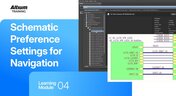
Embedded thumbnail for Altium Training - Navigating Schematics: Schematic Preference Settings for Navigation
Altium Training
Altium Training - Navigating Schematics: Schematic Preference Settings for Navigation

Unlock smarter design navigation in Altium! Learn how to customize navigation preferences to boost your design insight and visualize connectivity like never before. In this video, we’ll explore Design Insight settings, interactive connectivity hover features, and quick thumbnail navigation between schematic sheets. All designed to make your workflow faster, clearer, and more intuitive.

Embedded thumbnail for PCB Design Tools for Every Team Size: Altium's New Approach
How-To's
PCB Design Tools for Every Team Size: Altium's New Approach

Explore how Altium is transforming PCB design with software solutions built for teams of every size. In this exclusive PCB West 2025 interview, Justin Sears highlights the key distinctions between Altium Develop and Altium Agile helping you identify the ideal platform for your design needs.

Embedded thumbnail for PCB Design: Sequential Lamination vs Sub-Lamination
How-To's
PCB Design: Sequential Lamination vs Sub-Lamination

Explore the key distinctions between sequential lamination and sub-lamination techniques, and learn how each approach influences microvia placement, board complexity, and design flexibility in high-density interconnect (HDI) circuit board fabrication.


Embedded thumbnail for PCB Design Review: Power Meter Layout Deep Dive
How-To's
PCB Design Review: Power Meter Layout Deep Dive

Gain practical insights into PCB design with an in-depth power meter project review, covering parameter optimization, BOM control, and IPC-compliant high-voltage spacing.

Embedded thumbnail for Drawing Tools for Pro Schematics in Altium
How-To's
Drawing Tools for Pro Schematics in Altium

In our brand-new tutorial, you’ll learn how to create professional-looking schematics in Altium using built-in drawing tools and features. We’ll show you how to add custom title blocks, revision histories, tables of contents, block diagrams, and color schemes to make your schematics stand out.

Embedded thumbnail for 3 GHz RF Amplifier Deep Dive
How-To's
3 GHz RF Amplifier Deep Dive

Check out our design review of a 3.6 GHz RF amplifier! This in-depth analysis highlights schematic issues, PCB layout challenges, and key RF design principles to help you build better high-frequency circuits.

Embedded thumbnail for The Right Way to Use SIG/GND/PWR/SIG Stackups
How-To's
The Right Way to Use SIG/GND/PWR/SIG Stackups

Find out how to properly implement signal-ground-power-signal stackups in 4-layer PCB designs. Check out our tutorial from Zach Peterson, where he explains when to use dedicated power layers, how to route signals correctly over split power planes, and common mistakes to avoid for optimal EMI performance and signal integrity.

Embedded thumbnail for Altium Training - Design Environment: Documents and Panels
Altium Training
Altium Training - Design Environment: Documents and Panels

In our new tutorial, we explore different panel display modes, including docked, floating, and tabbed grouping arrangements. Effective panel management is essential for creating an efficient design environment tailored to your specific workflow requirements.

Embedded thumbnail for Mechanically Drilled Blind & Buried Vias: PCB Design Rules Explained
How-To's
Mechanically Drilled Blind & Buried Vias: PCB Design Rules Explained

Discover the essential design rules and manufacturing processes for mechanically drilled blind and buried vias in PCB layouts in this comprehensive tutorial. We cover the stack drill-and-plate fabrication process, aspect ratio limitations, sub-lamination design, and copper weight considerations. You’ll also learn how these vias differ from HDI microvias and gain a clear understanding of the critical design constraints needed for successful PCB manufacturing.

Embedded thumbnail for Altium Training - Design Environment: Navigation with Schematic Workspace
Altium Training
Altium Training - Design Environment: Navigation with Schematic Workspace

Discover the most important navigation techniques for the schematic workspace using both mouse and keyboard controls. In this tutorial video, you’ll learn how to use the View menu commands for document fitting, area zooming, and object selection, along with advanced navigation shortcuts. Master mouse-based panning and zooming, explore Ctrl key combinations, and practice arrow key movements - all designed to simplify your workflow in the PCB design process.

Embedded thumbnail for Altium Training - Design Environment: The Altium Environment
How-To's
Altium Training - Design Environment: The Altium Environment

Get familiar with the core workspace layout and navigation methods. In this video, you’ll see how to open schematic and PCB documents, work within the unified design environment, and move between multiple open files using document tabs and keyboard shortcuts.

Tag
Your search returns no results.