
Welcome, Guest

Sign in to learn, create, and do more with the product you love.

News & Updates

Filters:
Tag
NEW
Embedded thumbnail for Just Released: ODB++ Intellectual Property Protection
New in Altium's Software
Just Released: ODB++ Intellectual Property Protection

ODB++ Intellectual Property Protection lets you control exactly what design data is included in the ODB++ output, ensuring each manufacturing partner receives only the information needed for their specific fabrication or assembly tasks.

NEW
Blog
How to Design a PCB: From Schematic Capture to Manufacturing

This article walks through the complete PCB design workflow, from schematic capture and component selection to layout, design reviews, and manufacturing documentation. It highlights the key decisions at each stage that help engineering teams produce reliable, manufacturable products.

NEW
Embedded thumbnail for Future of Electronics Development in Security and Aerospace
How-To's
Future of Electronics Development in Security and Aerospace

See the highlights from Altium's executive event in Hamburg, where Security and Aerospace leaders explored AI-driven development, digital engineering, supply chain resilience, and the future of mission-critical electronics.

NEW
Blog
5 Power Integrity Myths: AC Edition

The biggest threat to your power integrity might be outdated design advice. This article challenges five common AC power integrity myths and shows what really matters when designing today's high-speed PCBs.

Embedded thumbnail for Create Clearance Rules Faster and with Less Effort
New in Altium's Software
Create Clearance Rules Faster and with Less Effort

Setting up clearance rules is now more intuitive in the Constraint Manager. Choose the Simple view for faster configuration with grouped object types, or the Advanced view when you need detailed, matrix-based clearance control.

Blog
Your Design Data Has Zero Defense

Your design data may be more exposed than you think. This webinar shows how to identify common security gaps and secure engineering workflows with centralized access control and governance.

Embedded thumbnail for Mastering HDI Design Rules in Altium Designer
How-To's
Mastering HDI Design Rules in Altium Designer

In our latest Altium Academy tutorial, we guide you through configuring the essential HDI PCB design rules in Altium's software. You'll learn how to use your manufacturer's fabrication capabilities to create accurate design rules and constraints for your PCB.

Embedded thumbnail for Search, Filter, and Navigate PCB Designs Faster
New in Altium's Software
Search, Filter, and Navigate PCB Designs Faster

The Web Viewer now features a redesigned search experience for faster access to PCB design data across supported CAD formats. A lightweight, intuitive interface lets you begin with simple search terms and progressively refine results using contextual suggestions.

Blog
Integrated PCB Design vs. Legacy Point Tools: What’s the Real Cost?

As hardware development grows more collaborative, disconnected point tools can introduce data inconsistencies, traceability gaps, and costly coordination challenges. This article examines how integrated PCB design environments connect design, mechanical, supply chain, and review workflows to improve efficiency throughout the product lifecycle.

Blog
Make Better Design Decisions with Signal and Power Integrity Insight

Signal integrity and power integrity are closely connected, with problems in one often affecting the other as designs become faster and more complex. This webinar explains how integrated analysis workflows help engineers evaluate PDN performance, identify potential issues early, and improve overall design quality.

Embedded thumbnail for Gain Better Control Over Wire Bond Visibility
New in Altium's Software
Gain Better Control Over Wire Bond Visibility

New bond wire visibility controls give you greater flexibility when working with wire-bonded boards and footprints, making it easier to focus on the details that matter most.

Embedded thumbnail for Coming Soon: Selectable Harness Source Within Multi-board Design
New in Altium's Software
Coming Soon: Selectable Harness Source Within Multi-board Design

Selectable Harness Source Within Multi-board Design enables harness projects to drive system connectivity while maintaining bidirectional synchronization between multi-board schematics and harness wiring diagrams for improved accuracy and easier design management.

Embedded thumbnail for Choose the Simbeor Version for Your PCB Calculations
New in Altium's Software
Choose the Simbeor Version for Your PCB Calculations

The PCB Editor now lets you choose the Simbeor version used for delay and impedance calculations, giving you more flexibility and consistency across your design workflows.

Blog
Agile Teams: From Design Tool to Product Development Platform

Learn how Agile Teams evolves beyond traditional PCB design workflows to support connected product development. This webinar explores how centralized data, collaboration tools, and governance capabilities help teams accelerate delivery while maintaining control.

Tag
How To Import Libraries and Manage Components With Altium 365
Blog
How To Import Libraries and Manage Components With Altium 365

The problems you can experience with components and libraries are endless. These problems are the most significant source of design issues and the biggest reason behind respins, costing companies untold amounts of lost profit annually.
If you want to have a better understanding of how to use Altium 365 to maintain a strong and centralized library that is free of problems and headaches, you may want to consider attending this lecture.

The High-Speed PCB Stackup Design Challenge
Blog
The High-Speed PCB Stackup Design Challenge

As much as we would like to build every high speed PCB perfectly, with ideal SI/PI/EMI characteristics, it isn’t always possible due to many practical constraints. Sometimes a stackup can be “good enough,” even for a high-speed PCB. This always comes from the need to balance engineering constraints, functional requirements, and the need to ensure signal and power integrity in a high-speed design, and finally to ensure compliance with EMC requirements.

How I Improved My Collaboration Efficiency with Altium 365
Blog
How I Improved My Collaboration Efficiency with Altium 365

Involving the whole team that will bring a product to completion early on in the development cycle is vital to efficient development. Design reviews with all the relevant parties are critical at each step of the design process, starting with high-level component selection, then through the schematic capture and PCB layout stages. 

Countersink and Counterbore
Blog
Countersink and Counterbore

Ergonomics and convenience are important issues when designing a printed circuit board and the device as a whole. A lot of Altium Designer tools are aimed at solving them. These include Countersink and Counterbore holes, which allow the use of various types of screws in the mounting holes of the board.

Migrating Data From Other Version Control Systems
Blog
Migrating Data From Other Version Control Systems

The development of electronic devices always involves the release of many different types of files. And these files are not static - they change as the project progresses. When filling a project with data, a user creates new files, modifies outdated files that have become irrelevant. Managing project data is a separate task, especially for large developments where several participants with different specializations are involved in the process.

Properties Panel Tuning
Blog
Properties Panel Tuning

High-speed PCBs often require tuning groups of tracks, both single and differential. Altium Designer includes powerful tools that allow you to solve such tasks quickly and with high quality. Study this document and achieve the desired result even faster.

Reflectionless Matching vs. Conjugate Matching: An Apparent Contradiction
Blog
Reflectionless Matching vs. Conjugate Matching: An Apparent Contradiction

There is one confusion related to impedance matching that comes up again and again, and it appears to be a fundamental confusion between reflection and power delivery. This leads to an apparent contradiction that arises when we try to generalize power delivery to wave reflection, despite the fact that the two were not meant to be related.

Properties Panel Routing
Blog
Properties Panel Routing

Routing is one of the most time-consuming stages of PCB design. Altium Designer has a large set of tools that allow you to do it as accurately and quickly as possible. This document will help you to learn how to manage your routing effectively and use it to its fullest extent.

Quarter-Wave Transformer Design For Real and Reactive Loads
Blog
Quarter-Wave Transformer Design For Real and Reactive Loads

RF systems operate with specific impedance values across entire interconnects, including on PCBs. Not all RF components are packaged in integrated circuits with defined impedances, so impedance matching circuits and line sections are needed to ensure signal transmission between different sections of an interconnect. One of these impedance matching techniques is the quarter-wave impedance transformer, which can be implemented as a printed trace with specific impedance.

Schematic
Blog
Altium Designer 22.10 Update

We are happy to announce that the Altium Designer 22.10 update is now available. Altium Designer 22.10 continues to focus on improving the user experience, as well as performance and stability of the software, based on feedback from our users. Check out the key new features in the What's New section on the left side of this window!

Component Warpage Causes in a PCB
Blog
Component Warpage Causes in a PCB

A staff member at a PCB manufacturer once explained to me that they thought we were having an issue with a package warping. Unfortunately, component warping can occur both in a PCB and in components. In this article, we'll give an overview of warpage in a PCB, specifically in the circuit board and in the components.

Link Budget Calculator
Blog
RF Signal Chain and Link Budget Basics

If you're designing a wireless IoT device, and you know how to calculate the link budget, you can reasonably estimate whether your signal will reach its destination and be read by the receiver. To calculate the link budget, the designer needs to know something about all other sources of gain and loss in the system. Once link budget is determined, the designer can judge whether some modification is needed in their RF signal chain. 

How to Calculate SMD Pad Sizes?
Blog
Best Methods for Calculating SMD Pad Size in PCB Design

SMD components require precisely sized pads for soldering during assembly. The designer is responsible for ensuring pad sizes are correct, either by calculating them and comparing with footprint data, looking through datasheets, or by memorizing SMD pad size standards. If you have a component and you don't have access to the footprint, and you decide to biuld the footprint yourself, what resources are available to ensure you have the correct pad size?

Can You Fix a Warped PCB?
Blog
Can You Fix a Warped PCB?

Before we get too deep into this article, I’ll give you the simple answer. You probably can’t fix warping in your PCB after it’s already been fabricated. You can prevent an unwarped board from becoming warped during assembly, but only as long as materials were selected properly and the board is put into reflow correctly. We’ll run over some of these points in this article, and I’ll examine some points that might help you recover a warped board.

What is an Eye Diagram?
Blog
What is an Eye Diagram?

The eye diagram is a useful measurement or simulation as part of channel compliance. The measurement shows many different factors that can affect signal behavior simultaneously, ultimately allowing for qualification of errors and losses in a channel. In this article, I’ll run over some of the fundamental measurements that you could manually extract from an eye diagram and how they reveal some strategies for improving channel designs.

Skills for Today's PCB Designers
Blog
What Skills Are Needed to be a PCB Layout Designer?

To readers who have been working in the PCB industry for most of your career, you have probably seen a very diverse group of professionals with varied skill sets and backgrounds. Designers might get started as engineers or as technicians, and some designers learn how to create beautiful PCB layouts in university. No matter how you got into PCB design, there are some important skills to know that will take you a long way towards advancing your career.

Tag
Embedded thumbnail for Creating and using templates
How to Work with Draftsman
Creating and using templates

Draftsman Templates are a quick way of laying out your Draftsman Document in Altium Designer. We’ll show you how to utilize them and the differences between sheet and document templates.

Embedded thumbnail for Adding 3D Assemblies to a Multi-Board Project
How to work with Multiboard
Adding 3D Assemblies to a Multi-Board Project

The next step in the multiboard design process is adding 3D PCB Assemblies. We’ll show you how to add them to your design and how to work with the Assembly Editor.

Embedded thumbnail for Altium 365 - Design Collaboration | Tasks
Getting Started with A365
Altium 365 - Design Collaboration | Tasks

The Tasks feature brings lightweight task tracking to further enhance design collaboration in Altium 365. With Tasks, you will never lose an important action item and easily gain a high-level view of the state of your project, all without leaving your design environment. 

Embedded thumbnail for Adding Additional Views in a Draftsman Document
How to Work with Draftsman
Adding Additional Views in a Draftsman Document

If you need additional views in your documentation, Altium Designer’s Draftsman Document editor can help. We’ll show you how to add and configure different views including the component view, the section view, the detail view, the isometric view, variants, the legend for the layer stack, the board region view, and the board realistic view.

Embedded thumbnail for Draftsman Document Views - Fabrication and Drill Drawings
How to Work with Draftsman
Draftsman Document Views - Fabrication and Drill Drawings

The Draftsman Document Editor allows you to add a fabrication view and a drill drawing view to your outjob files. We’ll show you how to get them set up and details you can control from the properties panel.

Embedded thumbnail for Altium 365 - Version Control | Project History
Getting Started with A365
Altium 365 - Version Control | Project History

Project History in a Nutshell: - Presents events in a chronological timeline (Creation, Commits, Releases, Clones, and MCAD Exchanges) - Auto-generates Differences Summary to view the differing entities (e.g., replaced components) - Even a non-expert can act on a revision (Download, View, Revert)

Embedded thumbnail for Resolving Conflicts in Multi-board Schematics
How to work with Multiboard
Resolving Conflicts in Multi-board Schematics

When mismatched pin names in your multi-board schematic cause disconnects and conflicts you can use Altium Designer’s tools to resolve these conflicts. We’ll show you the Connection Manager and the various solutions to solve your connection issues.

Embedded thumbnail for Draftsman Document Board Assembly View
How to Work with Draftsman
Draftsman Document Board Assembly View

The Draftsman Document can include a Board Assembly View. We’ll show you how to add it and the properties you can change to create the exact view or views you need.

Embedded thumbnail for Placing Connections Between Boards
How to work with Multiboard
Placing Connections Between Boards

A multi-board design requires relationships between several board designs referred to as interboard connections. We’ll show you the different types of connections and how to connect your boards using the proper connection type.

Embedded thumbnail for Show the Net Connections Between Select Components
How-To's
Show the Net Connections Between Select Components

This video demonstrates how to show net-specific component connections. This is helpful when routing as you’re able to reduce clutter and focus on the connections on which you are working.

Embedded thumbnail for Draftsman Editor Settings
How to Work with Draftsman
Draftsman Editor Settings

In this video we’ll go over the Draftsman editor settings and properties so you know how to set up the editor to be exactly what you need.

Embedded thumbnail for Assuring Your Board Is Large Enough to House All Components
How-To's
Assuring Your Board Is Large Enough to House All Components

This video covers how to make sure your board is big enough to house all your components.

Embedded thumbnail for How to Create an Interactive PDF of a Schematic Diagram
How-To's
How to Create an Interactive PDF of a Schematic Diagram

This video shows how to create an interactive PDF using the Smart PDF Wizard.

Embedded thumbnail for What is the Draftsman Document?
How to Work with Draftsman
What is the Draftsman Document?

Once your PCB layout is finished it’s time for review. This is where the Draftsman Document and Altium Designer’s Draftsman Editor comes in.

Embedded thumbnail for Adding Project Modules to a Multi-board Schematic
How to work with Multiboard
Adding Project Modules to a Multi-board Schematic

If you’re using multiple PCBs in your Multi-board design, Altium Designer allows you to add existing projects directly to your schematic with modules. We’ll show you how to quickly and efficiently add these projects to your Multi-board design.

Embedded thumbnail for Checking for Creepage in High Voltage Designs
How-To's
Checking for Creepage in High Voltage Designs

High voltage devices have leakage currents that propage over the surface of the board. In such devices, it's important to consider not only the standard gap between the two topological elements, but also the shortest possible path between them, taking into account cut-outs and holes. With Altium Designer 20, you can check for creepage using the new creepage distance rule.

Tag
Integrating Requirements June 2025 Webinar
On-Demand Webinar May 28, 2025
Integrating Requirements into Your PCB Design Workflow
Join our webinar where you will learn about integrated requirements tools who can help you eliminate late-stage design changes, AI support through system requirements and integration of design requirements directly in PCB Design. Don't miss it, register now!
Streamlining Team Collaboration
On-Demand Webinar Apr 17, 2025
Streamlining Team Collaboration in Industrial PCB Projects
Join us for our upcoming webinar to discover how Altium Designer and Altium 365 can transform your team’s collaboration and take your PCB design projects to the next level. Attend for a chance to win free access to the Altium 365 Training Bundle.
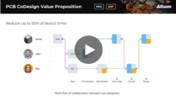
PCB CoDesign Webinar
On-Demand Webinar Jan 24, 2024
Discover How Altium Designer 24 Revolutionizes Team Dynamics in PCB Design
Expand your collaboration skills and stay ahead of the curve with PCB CoDesign. Design teams often grapple with prolonged design cycles and coordination issues, leading to delays and inefficiencies. In the current landscape, design processes are hindered by fragmented collaboration, resulting in increased layout times and difficulties in synchronizing design updates.