
Welcome, Guest

Sign in to learn, create, and do more with the product you love.

News & Updates

Filters:
Tag
NEW
Blog
Are Your ECAD Tools Holding Back Engineers’ Productivity?

The article highlights that productivity issues often stem from tool limitations rather than engineer effort, especially as project complexity grows. ECAD tools that offer clear version control, cross-discipline integration, and workflow awareness are key to sustaining efficiency.

NEW
Embedded thumbnail for PCB Design Tips to Improve RF Power Amplifier Layout
How-To's
PCB Design Tips to Improve RF Power Amplifier Layout

Take a deeper look at RF power amplifier PCB design as we expand on our original 6 GHz RF signal generator tutorial with an in-depth design review. Discover essential layout optimization techniques such as switching regulator routing, feedback loop placement, stitching via implementation, and effective copper balancing.

NEW
Embedded thumbnail for How Altium's Assembly Assistant unifies Quantum Systems' Dev Process
Altium Stories
How Altium's Assembly Assistant unifies Quantum Systems' Dev Process

Quantum Systems develops unmanned drone systems for aerial intelligence and rapid, field-ready innovation. With the Assembly Assistant, their team streamlined a once tedious prototype build process, eliminating manual exports, file conversions, and unnecessary guesswork.

Embedded thumbnail for Creating Stacking Stripes for PCB Fabrication: Altium Tutorial
How-To's
Creating Stacking Stripes for PCB Fabrication: Altium Tutorial

Watch our new tutorial where we demonstrate how to place stacking stripes along the edge of a PCB and configure design rules to control clearances. In this video, you’ll learn how to create a dummy net, use the query system to apply rules specifically to stacking stripes, and leverage split planes on internal layers.

Embedded thumbnail for Empower Your Designs with Advanced Power Analysis
How-To's
Empower Your Designs with Advanced Power Analysis

Power Analyzer brings clarity. Agile Teams brings control. Combined, they help teams deliver reliable hardware with confidence.

Blog
7 Ways to Catch Rules & Constraints Early – Checklist

Discover seven actionable ways to spot and fix rules and constraint issues before they derail your PCB project. Using Altium Designer Agile, these tips help you build more manufacturable and reliable boards with fewer iterations.

Embedded thumbnail for Component Selection Process Tips for PCB Design
How-To's
Component Selection Process Tips for PCB Design

Explore our new component selection tutorial and learn Zach Peterson’s proven approach to finding and choosing parts that take your electronic designs from good to exceptional.

Blog
Do You Need an IPC-D-356 Netlist?

If your output package is Gerber-based, adding an IPC-D-356 netlist can dramatically improve how your design is reviewed and validated for production. Here’s when it matters, what it contains, and how to generate it quickly in Altium.

Embedded thumbnail for Signal Analyzer by Keysight Promo Video
How-To's
Signal Analyzer by Keysight Promo Video

Design faster, collaborate smarter, and catch signal integrity issues early with Altium Agile Teams and the Signal Integrity Analyzer by Keysight — both integrated directly into Altium Designer Agile. Check out our new promo video to learn more.

Embedded thumbnail for NFC Reader Testing: Flashing and Validating the Project
How-To's
NFC Reader Testing: Flashing and Validating the Project

Join Zach Peterson as we build and test an NFC reader board from start to finish. You’ll see how a custom NFC reader goes from manufacturing to working hardware, with step-by-step guidance on firmware flashing, power checks, and RFID tag detection.

Embedded thumbnail for Power Analyzer by Keysight Promo Video
How-To's
Power Analyzer by Keysight Promo Video

Unlock faster, more reliable PCB design with Altium Designer Agile Teams and Power Analyzer by Keysight. Integrated directly inside Altium Designer, this powerful combination enables fast, secure, and adaptive collaboration helping engineering teams move quickly, stay aligned, and scale confidently. Watch this short video to see how this software improves your PCB design process.

Blog
Avoid These Top 3 Power Distribution Failures in PCB Design

Power distribution issues can silently undermine your PCB’s reliability. This article uncovers the top three failure modes and shows how Power Analyzer by Keysight helps you catch them early in the design phase and how Altium Agile Teams turns those checks into structured team action.

Embedded thumbnail for Do 90-Degree Bends Destroy Signal Integrity? The Surprising Answer
How-To's
Do 90-Degree Bends Destroy Signal Integrity? The Surprising Answer

Discover why the long-held belief about 90-degree PCB traces may be more myth than reality. This video explains key signal integrity principles and uncovers insights that can help you make more informed design decisions.

Embedded thumbnail for Taking Control Without Adding Complexity – Presentation Embedded World North America 2025
New in Altium Designer 20
Taking Control Without Adding Complexity – Presentation Embedded World North America 2025

See how Altium makes project oversight faster and smarter with automated workflows, real-time tracking, and connected design data without adding work for engineers. Watch our Embedded World North America 2025 presentation to learn more.

Tag
Top 5 Questions Regarding Stack Up
Blog
SAP (Semi-Additive PCB Process) – Top 5 Questions Regarding Stack Up

As the PCB design community embraces the benefits of this new printed circuit board fabrication technique, there are of course many questions to be answered.  Today’s blog will address some of the most commonly asked questions related to circuit layer stack up as people are introduced to this new technology.

Design Reuse Blocks Update
Blog
Altium Designer 22.9 Update

We are happy to announce that the Altium Designer 22.9 update is now available. Altium Designer 22.9 continues to focus on improving the user experience, as well as performance and stability of the software, based on feedback from our users. Check out the key new features in the What's New section on the left side of this window!

Dual Rail Voltage Supply
Blog
Dual Rail Voltage Supply

The highest performing operational amplifiers often need a split supply with positive and negative voltages connected to the op amps supply rails. In this project, we’re going to be building a positive/negative dual rail power supply for a differential oscilloscope probe I’m designing. I’m making the power supply a separate project, as a dual rail supply is quite useful to have, and I’m sure I’ll find multiple uses for it in the future.

Library Importer Interface
Blog
Library Importer Improvements (former Library Migrator)

Importing file-based libraries from your local computer or network drive to your Altium 365 workspace can be done using the Library Importer. Altium’s Library Migrator was renamed Library Importer—the feature’s name was changed to conform more closely to the tool’s purpose. Not only is its name new, but our team has also made several user experience improvements. We have updated the documentation to reflect this change.

Blog
How to Select Copper Foil for High-Frequency PCB Design

The PCB materials industry has spent significant amounts of time developing materials that provide lowest possible signal loss for products with RF applications. For high speed and high frequency designs, losses will limit signal propagation distance and distort signals, and it will create an impedance deviation that can be seen in TDR measurements. In this article, we'll look at the balance between copper foil losses and other types of losses in a PCB, as well as some strategies that are commonly used to overcome roughness.

Blog
Altium Designer 22.8 Update

We are happy to announce that the Altium Designer 22.8 update is now available. Altium Designer 22.8 continues to focus on improving the user experience, as well as performance and stability of the software, based on feedback from our users. Check out the key new features in the What's New section on the left side of this window!

What is Hybrid Beamforming?
Blog
What is Hybrid Beamforming?

In this article, we’ll look at beamforming implementation in an advanced method combining analog and digital techniques, known as hybrid beamforming. This method blends both digital and analog techniques to create multiple beams and thus reach multiple users with varying intensities. In the case of an RF imaging system or a radar system, hybrid beamforming in a MIMO technique also allows tracking of multiple targets with adjustable resolution.

Is your via impedance calculator accurate?
Blog
Why Most Via Impedance Calculators Are Inaccurate

The problem with every via impedance calculator that I have seen is simple: they are incomplete or totally wrong. The “incomplete” part refers to a lack of context; these calculators can roughly reproduce a well-known estimate from a legend like Howard Johnson in his Digital Design textbooks. However, these calculators never provide insight into what they are actually calculating, or where the calculated via impedance is accurate. Keep reading to see why these calculators get it so wrong, as well as the context surrounding via impedance.

Blog
Buck Converter Simulation in Altium Designer

When designing high power circuits (usually very high voltage and/or current), you’ll need to create a regulator from scratch and place it in your PCB layout. It's also the case that you may want to model a real component using discretes in a simulation in order to qualify the system's expected operating regime. As part of buck converter design, you can easily run a buck converter simulation directly in Altium Designer’s schematic editor. Here’s how you can access these features in the newest version of Altium Designer. 

PCIe 6.0 Overview
Blog
Overview of the PCIe 6.0 Standard

Just as you get used to PCIe 5.0, they decide to release another standard! The newest iteration of PCIe is Gen6, or PCIe 6.0. PCIe 6.0 brings a doubling of channel bandwidth through introduction of PAM-4 as the signaling method in high-speed differential channels. This signaling method is a first for PCIe, and it’s an important enabler of the doubled data rate we see in the current standard. In this article, I’ll run over the important points in the standard and what PCB designers can expect when designing these channels.

SPI vs. I2C For Memory Access
Blog
SPI vs. I2C: How to Choose the Best Protocol for Your Memory Chips

One of the common implementations of SPI and I2C in a PCB layout is as a protocol for reading and writing to an external Flash memory. Flash chips are a very common component in embedded systems and can offer high capacities of non-volatile memory up to Gb values. When choosing a memory chip, you'll want to match the application requirements and functionality with the bus speed you need for read and write operations in your memory chip. There is also the matter of the type of Flash memory you'll need to access (NOR vs. NAND).

Blog
Is There an SPI Trace Impedance Requirement?

There is no SPI trace impedance requirement? The reality is that SPI lines only start to need impedance control when the length of the interconnect becomes very long. And because there is no specific impedance requirement in the bus, you have some freedom in channel design and termination. So what exactly qualifies as “very long” and when is some termination method needed? We’ll break it down in this article.

The Skin Effect and EM Fields
Blog
The Skin Effect, Current Density, and the Electromagnetic Field

During this year's AltiumLive CONNECT event, I recall receiving an interesting question about the skin effect and the distribution of current due to the presence of ground in coplanar transmission lines. In this article, we'll look at the electric field around a transmission line carrying a signal, and how this might be impacted by the skin effect.

Packaging for your PCBAs
Blog
What You Need for PCB Packaging and Shipping

When you get your PCBA back from an assembler, you’ll notice the packaging materials used to pack and ship the PCBA. Those materials are specific to electronics, and if you build products on behalf of clients, it’s important to know the packaging materials used for packing and shipping electronics. In this article I’ll show the main set of materials and equipment used to package electronics assemblies.

PCB Output files
Blog
How to Make PCB Gerber Files in Altium Designer Step-by-Step

Once you've got your PCB layout finished and you're ready to start preparing for manufacturing, one of the critical steps is to create PCB Gerber files. When you're ready to create your Gerber files, you need the right set of CAM processor tools that can take data from your PCB layout. In this article, we'll guide you through this process of how to make PCB Gerber files and show some example tasks you might need to perform to generate them.

Teardrops on Differential Pairs?
Blog
Should You Place Teardrops on Differential Pairs?

One of the major factors impacting reliability of a PCBA is the use of teardrops on traces in the PCB. Like many aspects of reliability, the considerations also span into the signal integrity domain, particularly as more high-reliability products require greater data handling capabilities and run at higher speeds. In this article, I’ll break down the issues present in teardrop usage on differential pairs and how these may affect impedance.

Tag
Embedded thumbnail for How to Reuse Board Shapes in MCAD
Working with MCAD CoDesigner extension
How to Reuse Board Shapes in MCAD

You can use the MCAD Co-designer panel to reuse your board shape or geometry in your PCB. We’ll show you how to use the MCAD Co-designer panel in Altium Designer and how to copy your board shape and geometry from your MCAD tool to Altium Designer.

Embedded thumbnail for Selection filter - Panel Properties and PCB
How to work with Selection
Selection filter - Panel Properties and PCB

Learn how to configure the types of selected objects using the Selection Filter. In addition, you will learn about the Post Selection Filter and its features.

Embedded thumbnail for PCB Origins During the ECAD MCAD Exchange
Working with MCAD CoDesigner extension
PCB Origins During the ECAD MCAD Exchange

Origins can vary from your MCAD tool and Altium Designer. With the MCAD Co-Designer panel Altium Designer can keep track of your origin point and make sure your design changes are exchanged correctly.

Embedded thumbnail for Global Editing Using Find Similar Objects
How to work with Selection
Global Editing Using Find Similar Objects

Editing multiple objects one by one can be a very time consuming process. Altium Designer makes this easy and efficient with the Find Similar Objects tool, which allows you to globally select and edit multiple objects at once.

Embedded thumbnail for Shaping the PCB in MCAD
Working with MCAD CoDesigner extension
Shaping the PCB in MCAD

Through the MCAD Co-designer in Altium Designer, you can collaborate with a mechanical engineer to shape the PCB in your MCAD tool and keep it updated in Altium Designer. We’ll show you how in Altium Designer and in your MCAD tool.

Embedded thumbnail for Cross Select Mode
How to work with Selection
Cross Select Mode

Cross Select Mode is a unique tool that allows for cross-selection of objects between the schematic and PCB thanks to the Altium Unified platform. This makes it easy to look for specific components, as well as take advantage of component placement tools.

Embedded thumbnail for Tools for Efficient Selection
How to work with Selection
Tools for Efficient Selection

Efficient selection tools can make a difference in how long and how clean your design can be. Learn how to utilize the Edit Select Menu tools in Altium Designer to take control over your layout.

Embedded thumbnail for Tools for Easily Selecting Objects in the PCB
How to work with Selection
Tools for Easily Selecting Objects in the PCB

Explore more than basic mouse movements by taking a look at the tools that Altium Designer has to offer for making selecting and moving objects in the PCB an easy task. This will increase your productivity and allow you to spend more time designing

Embedded thumbnail for How to Work with The Polygon Manager
Working with Polygons
How to Work with The Polygon Manager

It is important to have a high-level view of all polygons on the PCB design. The Polygon Manager lets you rename polygons, set their pour order, perform re-pouring or disable pouring on selected polygons, add/scope the polygon connection style and clearance design rules, and add polygon classes for selected polygons.

Embedded thumbnail for Assigning Impedance Profiles for Differential Pairs
How to Work with Differential Pairs
Assigning Impedance Profiles for Differential Pairs

When you assign an impedance profile to a differential pair you open up several options for control over your routes. We'll show you how to do just that, as well as how to fix errors that may pop up and how to create classes for differential pairs based on assigned impedance profiles.

Embedded thumbnail for How to Highlight or Select Net Connections in the PCB
How-To's
How to Highlight or Select Net Connections in the PCB

We’ll show you how to highlight net selections so you can easily track where connections are made. We’ll show you how to hide and show nets, and how to use the view configuration and PCB panels to view and highlight nets across your design, and how to assign net colors in both the PCB and the schematic.

Embedded thumbnail for Remove Unused Via Pads
How to Design a BGA
Remove Unused Via Pads

The Remove Unused Pad Shapes tool in Altium Designer gives you control over the via pads in your design. We’ll show you how to use it to increase the usable area of power and ground polygons, increase the density of conductors between hole rows, and fixing incorrect connections.

Embedded thumbnail for Tent Vias under BGA
How to Design a BGA
Tent Vias under BGA

When via are located close to component pads some soldering issues can arise, but this can be fixed with Tented vias. We’ll show you how to manually tent vias and how to tent vias through the Design Rules.

Embedded thumbnail for Via-in-Pad for BGA
How to Design a BGA
Via-in-Pad for BGA

We’ll teach you how to use Via-in-pad to reduce inductance, improve signal integrity, and improve power distribution system performance in BGA designs.

Embedded thumbnail for Using HDI Stackups during BGA Design
How to Design a BGA
Using HDI Stackups during BGA Design

Micro Vias and Buried Vias play an important role in high density interconnection layer stackups (HDI Stackups). We’ll show you how to add via and create rules to allow you to take full advantage of the HDI Stackup.

Embedded thumbnail for Automatic Fanout With BGA
How to Design a BGA
Automatic Fanout With BGA

When routing a BGA it can be necessary to use automatic fanout to make the routing process easier and faster. We’ll show you how to run the automatic fanout for routing a BGA and how the rules can affect the outcome of the route.

Tag
Integrating Requirements June 2025 Webinar
On-Demand Webinar May 28, 2025
Integrating Requirements into Your PCB Design Workflow
Join our webinar where you will learn about integrated requirements tools who can help you eliminate late-stage design changes, AI support through system requirements and integration of design requirements directly in PCB Design. Don't miss it, register now!
Streamlining Team Collaboration
On-Demand Webinar Apr 17, 2025
Streamlining Team Collaboration in Industrial PCB Projects
Join us for our upcoming webinar to discover how Altium Designer and Altium 365 can transform your team’s collaboration and take your PCB design projects to the next level. Attend for a chance to win free access to the Altium 365 Training Bundle.
PCB CoDesign Webinar
On-Demand Webinar Jan 24, 2024
Discover How Altium Designer 24 Revolutionizes Team Dynamics in PCB Design
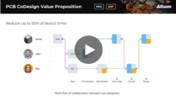
Expand your collaboration skills and stay ahead of the curve with PCB CoDesign. Design teams often grapple with prolonged design cycles and coordination issues, leading to delays and inefficiencies. In the current landscape, design processes are hindered by fragmented collaboration, resulting in increased layout times and difficulties in synchronizing design updates.