Welcome, Guest

Sign in to learn, create, and do more with the product you love.

News & Updates

Filters:
Tag
Embedded thumbnail for Coming Soon: Export 3D-MID Tracks as Centerline Curves
New in Altium Designer 25
Coming Soon: Export 3D-MID Tracks as Centerline Curves

Coming Soon: 3D-MID Track-to-Centerline Export allows you to export conductive tracks on 3D substrates as precise centerline curves within STEP files—enabling seamless integration with advanced 5-axis manufacturing processes. Explore more upcoming upgrades on our Coming Soon page.

Embedded thumbnail for Advanced xSignal and Impedance Control Techniques - Recording Preview
New in Altium Designer 25
Advanced xSignal and Impedance Control Techniques - Recording Preview

This webinar recording explores advanced xSignal and impedance control techniques in Altium Designer 25. It covers defining xSignals, managing impedance profiles, differential pairs, and delay tuning—all essential for high-speed PCB design. Full recording you find here: April 2025 COM Webinar Recording.

Embedded thumbnail for Coming Soon: Embedded 3D Models for Harness Designs
How-To's
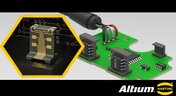
Coming Soon: Embedded 3D Models for Harness Designs

Coming soon: the Embedded 3D Models for Harness Designs feature will automatically include Parasolid-format 3D models in your harness layout drawings. This improves integration with MCAD CoDesigner, enabling seamless synchronization between electrical and mechanical design domains. To see more upcoming upgrades, visit our Coming Soon page.

Embedded thumbnail for Make Smarter Design Decisions with Signal Analyzer by Keysight
New in Altium Designer 25
Make Smarter Design Decisions with Signal Analyzer by Keysight

Discover how to simplify your workflow and boost design confidence with Signal Analyzer by Keysight—a complete extension available right inside Altium Designer 25. This whitepaper shows you how to analyze impedance, delay, and insertion/return loss without ever leaving your design environment.

Blog
Printed Electronics: The Future of Flexible and Cost-Effective Circuit Design

This article explores the rise of printed electronics as a lightweight, flexible, and cost-effective alternative to traditional PCB design. It highlights key benefits like reduced manufacturing costs, sustainability, and new design possibilities—especially in wearables, medical devices, and automotive applications. 

Embedded thumbnail for Unveiling 86% Task Time Efficiency in Altium Designer 25
Altium Designer's 25 Quantitative Benefits
Unveiling 86% Task Time Efficiency in Altium Designer 25

Watch how Altium Designer 25 saves time on PCB visualization. This short video shows a side-by-side comparison of the same task done in Altium Designer 25 vs. an external CAD tool—revealing big time and click savings. A great teaser to highlight the value of the unified design environment and promote the Benefit Calculator.

Embedded thumbnail for AGND vs PGND: Proper Net Tie Connections in Power Regulator PCB Design
How-To's
AGND vs PGND: Proper Net Tie Connections in Power Regulator PCB Design

What’s the difference between AGND and PGND — and when should you use a net tie? Zach Peterson breaks down proper PCB layout for buck converters, grounding best practices, and why component placement matters in switching regulator designs.

Blog
New Routing Possibilities with Ultra HDI

Explore how Ultra HDI technology is redefining PCB design. This article breaks down the benefits and manufacturing considerations of Ultra HDI, and how it enables next-level routing density and miniaturization in advanced electronics.

Blog
3D-MID in Focus: Principles, Processes, and Practical Use

This article introduces 3D-MID (Mechatronic Integrated Devices), a technology that integrates circuitry into 3D plastic structures to reduce size, weight, and complexity. It explains the production process, use cases, and benefits of 3D-MID in sectors like automotive, medical, and consumer electronics.

Embedded thumbnail for  Students at Monash UAS Fly Higher with Altium Solutions to Power Their Autonomous Drone Technology
Altium Stories
Students at Monash UAS Fly Higher with Altium Solutions to Power Their Autonomous Drone Technology

Discover how the Monash Uncrewed Aerial Systems team leverages Altium Designer, MCAD CoDesigner, and Altium 365 to develop custom drone boards for critical humanitarian missions.

Blog
Eliminate EMI and Signal Integrity Issues in Multi-Board PCB Designs

Ensure signal integrity and minimize EMI in complex electronics. Our new article explains how to address electromagnetic interference and signal integrity challenges in multi-board PCB designs, offering practical strategies and layout considerations for reliable system performance.

Embedded thumbnail for Say Goodbye to Disjointed Workflows: Unified Product Design in Altium Designer 25
New in Altium Designer 25
Say Goodbye to Disjointed Workflows: Unified Product Design in Altium Designer 25

Check an overview of how Altium Designer 25 unifies Multi-Board and Harness Design into a seamless, efficient workflow for faster, error-free product development.

Embedded thumbnail for From Concept to Reality: Updated 3D-MID Demo in Altium Designer 25
New in Altium Designer 25
From Concept to Reality: Updated 3D-MID Demo in Altium Designer 25

A walkthrough of the new 3D-MID capabilities in Altium Designer 25. Covers setting up a 3D PCB document, component placement on curved surfaces, routing with grids and sketches, exporting for LDS manufacturing, and generating a 3D pick-and-place file.

Embedded thumbnail for Take 66% of Your Time Back with Custom Pad Stack in Altium Designer 25
Altium Designer's 25 Quantitative Benefits
Take 66% of Your Time Back with Custom Pad Stack in Altium Designer 25

This video demonstrates the measurable productivity gains of using the Custom Pad Stack tool in Altium Designer 25. It compares a detailed QFN-32 footprint customization process across versions, showing a significant reduction in time and mouse clicks—2 min 5 sec vs. 6 min 2 sec, and 45 vs. 116 clicks.

Blog
Mastering Component Templates in Altium Designer 25

Our new article by Dario Fresu explains how Component Templates in Altium Designer 25 Pro improve design consistency, reduce errors, and streamline collaboration. It highlights practical benefits like standardized naming, faster component creation, and scalability across projects. Includes examples of using templates with Altium 365™ to simplify complex component setup.

Tag
How to Fix the Top PCB Design Mistakes
Blog
Beginner PCB Design Mistakes and How To Avoid Them

When starting out with PCB design, it’s common to treat the process as simply ‘connecting the dots’: as long as connections are made, it’s not particularly important how these connections are made. Having reviewed quite a number of PCBs of other PCB design engineers over the last few years, there are common, unfortunately erroneous, occurrences between a lot of them. This article aims to illustrate the top five beginner PCB design mistakes and what we can do to avoid making them. Let’s get started!

Top 5 Questions Regarding Stack Up
Blog
SAP (Semi-Additive PCB Process) – Top 5 Questions Regarding Stack Up

As the PCB design community embraces the benefits of this new printed circuit board fabrication technique, there are of course many questions to be answered.  Today’s blog will address some of the most commonly asked questions related to circuit layer stack up as people are introduced to this new technology.

Design Reuse Blocks Update
Blog
Altium Designer 22.9 Update

We are happy to announce that the Altium Designer 22.9 update is now available. Altium Designer 22.9 continues to focus on improving the user experience, as well as performance and stability of the software, based on feedback from our users. Check out the key new features in the What's New section on the left side of this window!

Dual Rail Voltage Supply
Blog
Dual Rail Voltage Supply

The highest performing operational amplifiers often need a split supply with positive and negative voltages connected to the op amps supply rails. In this project, we’re going to be building a positive/negative dual rail power supply for a differential oscilloscope probe I’m designing. I’m making the power supply a separate project, as a dual rail supply is quite useful to have, and I’m sure I’ll find multiple uses for it in the future.

Library Importer Interface
Blog
Library Importer Improvements (former Library Migrator)

Importing file-based libraries from your local computer or network drive to your Altium 365 workspace can be done using the Library Importer. Altium’s Library Migrator was renamed Library Importer—the feature’s name was changed to conform more closely to the tool’s purpose. Not only is its name new, but our team has also made several user experience improvements. We have updated the documentation to reflect this change.

Blog
How to Select Copper Foil for High-Frequency PCB Design

The PCB materials industry has spent significant amounts of time developing materials that provide lowest possible signal loss for products with RF applications. For high speed and high frequency designs, losses will limit signal propagation distance and distort signals, and it will create an impedance deviation that can be seen in TDR measurements. In this article, we'll look at the balance between copper foil losses and other types of losses in a PCB, as well as some strategies that are commonly used to overcome roughness.

Blog
Altium Designer 22.8 Update

We are happy to announce that the Altium Designer 22.8 update is now available. Altium Designer 22.8 continues to focus on improving the user experience, as well as performance and stability of the software, based on feedback from our users. Check out the key new features in the What's New section on the left side of this window!

What is Hybrid Beamforming?
Blog
What is Hybrid Beamforming?

In this article, we’ll look at beamforming implementation in an advanced method combining analog and digital techniques, known as hybrid beamforming. This method blends both digital and analog techniques to create multiple beams and thus reach multiple users with varying intensities. In the case of an RF imaging system or a radar system, hybrid beamforming in a MIMO technique also allows tracking of multiple targets with adjustable resolution.

Is your via impedance calculator accurate?
Blog
Why Most Via Impedance Calculators Are Inaccurate

The problem with every via impedance calculator that I have seen is simple: they are incomplete or totally wrong. The “incomplete” part refers to a lack of context; these calculators can roughly reproduce a well-known estimate from a legend like Howard Johnson in his Digital Design textbooks. However, these calculators never provide insight into what they are actually calculating, or where the calculated via impedance is accurate. Keep reading to see why these calculators get it so wrong, as well as the context surrounding via impedance.

Blog
Buck Converter Simulation in Altium Designer

When designing high power circuits (usually very high voltage and/or current), you’ll need to create a regulator from scratch and place it in your PCB layout. It's also the case that you may want to model a real component using discretes in a simulation in order to qualify the system's expected operating regime. As part of buck converter design, you can easily run a buck converter simulation directly in Altium Designer’s schematic editor. Here’s how you can access these features in the newest version of Altium Designer. 

PCIe 6.0 Overview
Blog
Overview of the PCIe 6.0 Standard

Just as you get used to PCIe 5.0, they decide to release another standard! The newest iteration of PCIe is Gen6, or PCIe 6.0. PCIe 6.0 brings a doubling of channel bandwidth through introduction of PAM-4 as the signaling method in high-speed differential channels. This signaling method is a first for PCIe, and it’s an important enabler of the doubled data rate we see in the current standard. In this article, I’ll run over the important points in the standard and what PCB designers can expect when designing these channels.

SPI vs. I2C For Memory Access
Blog
SPI vs. I2C: How to Choose the Best Protocol for Your Memory Chips

One of the common implementations of SPI and I2C in a PCB layout is as a protocol for reading and writing to an external Flash memory. Flash chips are a very common component in embedded systems and can offer high capacities of non-volatile memory up to Gb values. When choosing a memory chip, you'll want to match the application requirements and functionality with the bus speed you need for read and write operations in your memory chip. There is also the matter of the type of Flash memory you'll need to access (NOR vs. NAND).

Blog
Is There an SPI Trace Impedance Requirement?

There is no SPI trace impedance requirement? The reality is that SPI lines only start to need impedance control when the length of the interconnect becomes very long. And because there is no specific impedance requirement in the bus, you have some freedom in channel design and termination. So what exactly qualifies as “very long” and when is some termination method needed? We’ll break it down in this article.

The Skin Effect and EM Fields
Blog
The Skin Effect, Current Density, and the Electromagnetic Field

During this year's AltiumLive CONNECT event, I recall receiving an interesting question about the skin effect and the distribution of current due to the presence of ground in coplanar transmission lines. In this article, we'll look at the electric field around a transmission line carrying a signal, and how this might be impacted by the skin effect.

Packaging for your PCBAs
Blog
What You Need for PCB Packaging and Shipping

When you get your PCBA back from an assembler, you’ll notice the packaging materials used to pack and ship the PCBA. Those materials are specific to electronics, and if you build products on behalf of clients, it’s important to know the packaging materials used for packing and shipping electronics. In this article I’ll show the main set of materials and equipment used to package electronics assemblies.

PCB Output files
Blog
How to Make PCB Gerber Files in Altium Designer Step-by-Step

Once you've got your PCB layout finished and you're ready to start preparing for manufacturing, one of the critical steps is to create PCB Gerber files. When you're ready to create your Gerber files, you need the right set of CAM processor tools that can take data from your PCB layout. In this article, we'll guide you through this process of how to make PCB Gerber files and show some example tasks you might need to perform to generate them.

Tag
Embedded thumbnail for PCB Design Tips to Improve RF Power Amplifier Layout
How-To's
PCB Design Tips to Improve RF Power Amplifier Layout

Take a deeper look at RF power amplifier PCB design as we expand on our original 6 GHz RF signal generator tutorial with an in-depth design review. Discover essential layout optimization techniques such as switching regulator routing, feedback loop placement, stitching via implementation, and effective copper balancing.

Embedded thumbnail for How Altium's Assembly Assistant unifies Quantum Systems' Dev Process
Altium Stories
How Altium's Assembly Assistant unifies Quantum Systems' Dev Process

Quantum Systems develops unmanned drone systems for aerial intelligence and rapid, field-ready innovation. With the Assembly Assistant, their team streamlined a once tedious prototype build process, eliminating manual exports, file conversions, and unnecessary guesswork.

Embedded thumbnail for Creating Stacking Stripes for PCB Fabrication: Altium Tutorial
How-To's
Creating Stacking Stripes for PCB Fabrication: Altium Tutorial

Watch our new tutorial where we demonstrate how to place stacking stripes along the edge of a PCB and configure design rules to control clearances. In this video, you’ll learn how to create a dummy net, use the query system to apply rules specifically to stacking stripes, and leverage split planes on internal layers.

Embedded thumbnail for Empower Your Designs with Advanced Power Analysis
How-To's
Empower Your Designs with Advanced Power Analysis

Power Analyzer brings clarity. Agile Teams brings control. Combined, they help teams deliver reliable hardware with confidence.

Embedded thumbnail for Component Selection Process Tips for PCB Design
How-To's
Component Selection Process Tips for PCB Design

Explore our new component selection tutorial and learn Zach Peterson’s proven approach to finding and choosing parts that take your electronic designs from good to exceptional.

Embedded thumbnail for Signal Analyzer by Keysight Promo Video
How-To's
Signal Analyzer by Keysight Promo Video

Design faster, collaborate smarter, and catch signal integrity issues early with Altium Agile Teams and the Signal Integrity Analyzer by Keysight — both integrated directly into Altium Designer Agile. Check out our new promo video to learn more.

Embedded thumbnail for NFC Reader Testing: Flashing and Validating the Project
How-To's
NFC Reader Testing: Flashing and Validating the Project

Join Zach Peterson as we build and test an NFC reader board from start to finish. You’ll see how a custom NFC reader goes from manufacturing to working hardware, with step-by-step guidance on firmware flashing, power checks, and RFID tag detection.

Embedded thumbnail for Power Analyzer by Keysight Promo Video
How-To's
Power Analyzer by Keysight Promo Video

Unlock faster, more reliable PCB design with Altium Designer Agile Teams and Power Analyzer by Keysight. Integrated directly inside Altium Designer, this powerful combination enables fast, secure, and adaptive collaboration helping engineering teams move quickly, stay aligned, and scale confidently. Watch this short video to see how this software improves your PCB design process.

Embedded thumbnail for Do 90-Degree Bends Destroy Signal Integrity? The Surprising Answer
How-To's
Do 90-Degree Bends Destroy Signal Integrity? The Surprising Answer

Discover why the long-held belief about 90-degree PCB traces may be more myth than reality. This video explains key signal integrity principles and uncovers insights that can help you make more informed design decisions.

Embedded thumbnail for Taking Control Without Adding Complexity – Presentation Embedded World North America 2025
New in Altium Designer 20
Taking Control Without Adding Complexity – Presentation Embedded World North America 2025

See how Altium makes project oversight faster and smarter with automated workflows, real-time tracking, and connected design data without adding work for engineers. Watch our Embedded World North America 2025 presentation to learn more.

Embedded thumbnail for Demonstration Altium DISCOVER - Embedded World North America 2025
Embedded World 2025
Demonstration Altium DISCOVER - Embedded World North America 2025

Check out our live demo from Embedded World North America 2025 showcasing Octopart Discover. In this video, you’ll see how the platform helps reduce sourcing risk, shorten design cycles, and keep projects moving forward with confidence.

Embedded thumbnail for Altium Agile for Modern Electronics Development - Presentation Embedded World North America 2025
Embedded World 2025
Altium Agile for Modern Electronics Development - Presentation Embedded World North America 2025

Watch our presentation from Embedded World North America 2025 to learn how Altium Agile brings structure, visibility, and velocity to modern hardware development. Discover how multidisciplinary teams can eliminate workflow chaos, track progress in real time, and accelerate delivery without compromising quality.

Embedded thumbnail for Demonstration Altium DEVELOP - Embedded World North America 2025
Embedded World 2025
Demonstration Altium DEVELOP - Embedded World North America 2025

See how Altium Develop empowers engineering teams with fast, cloud-connected PCB design built for modern collaboration. This live demo from Embedded World North America 2025 showcases real-time co-creation, smooth MCAD-ECAD integration, and a design environment that lets you stay focused on what matters building great products.

Embedded thumbnail for From Collaboration to Co Creation – Presentation Embedded World North America 2025
Embedded World 2025
From Collaboration to Co Creation – Presentation Embedded World North America 2025

In this Embedded World North America 2025 presentation, learn how Altium enables electrical, mechanical, firmware, sourcing, and manufacturing teams to collaborate seamlessly in real time through shared data, shared context, and shared visibility. Experience how unified workflows reduce rework, speed up decision-making, and empower teams to deliver exceptional products faster.

Embedded thumbnail for PCB Design: Defining Electrical Clearances in High Voltage PCBs
How-To's
PCB Design: Defining Electrical Clearances in High Voltage PCBs

Unlock the essential principles behind defining electrical clearances for high-voltage PCB designs in our brand-new tutorial. Learn how to apply accurate, layer-specific clearance rules using IPC-2221 standards and harness the full power of Altium’s query system.

Embedded thumbnail for Demonstration Altium AGILE Enterprise - Embedded World North America 2025
Embedded World 2025
Demonstration Altium AGILE Enterprise - Embedded World North America 2025

Experience how Altium Agile Enterprise turns complex engineering collaboration into a streamlined, unified workflow. In this live demonstration from Embedded World North America 2025, you’ll see how multi-disciplinary teams can simplify processes, minimize rework, and maintain clear alignment from requirements through release. All within a single, powerful platform.

Tag
Your search returns no results.