Welcome, Guest

Sign in to learn, create, and do more with the product you love.

News & Updates

Filters:
Tag
Embedded thumbnail for Coming Soon: Automatic Multi-Net Tuning
How-To's
Coming Soon: Automatic Multi-Net Tuning

Automatic Multi-Net Tuning enhances PCB design accuracy and efficiency by automatically adjusting multiple nets simultaneously to meet specific design rules, including length and delay. Learn more about this feature, which will be released on December 13th. Its flexibility enables effective work with differential pairs and traces at any angle. It not only identifies but also rectifies issues related to automatic length tuning, ensuring your designs adhere to key standards without the need for manual adjustments.

Blog
How to Design for Test in Embedded Systems

Whether you're designing a high-speed PCB, or a complex embedded system, it will need some level of testing. In this article, we will show you some simple tricks that can make testing and debugging a prototype much easier. 

Embedded thumbnail for Coming Soon: PCB CoDesign
How-To's
Coming Soon: PCB CoDesign

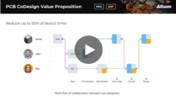
PCB CoDesign makes it easier for everyone to work together and meet project deadlines. In Altium Designer 24, which is scheduled for release on December 13th, we are introducing a new feature. This feature optimizes your resources through a Git-like approach, allowing multiple team members to work simultaneously and commit changes to a master branch. This expedites the design process and lowers project costs.

Blog
Crosstalk Basics in PCB Design

Crosstalk is one of the most common issues related to electronics. Learn the basics of this phenomenon in PCB design, and gain knowledge on how to avoid it in your projects.

Embedded thumbnail for Coming Soon: MultiBoard Draftsman
How-To's
Coming Soon: MultiBoard Draftsman

MultiBoard Draftsman enhances the efficiency of design reviews and assembly precision by offering a unified platform for detailed viewing and documentation of MultiBoard Designs. Discover more about this feature in our brand-new short video.

Embedded thumbnail for Coming Soon: PCB Layout Replication
How-To's
Coming Soon: PCB Layout Replication

PCB Layout Replication allows quick replication of layouts for repetitive circuitry blocks in a flat PCB design. In this short video we will show you how this new tool (scheduled for release on December 13th) eliminates the need to do repetitive tasks manually or for various workarounds like snippets or multi-channel designs.

Blog
Access to your Training Certificates on My Altium

Introduce an update on the My Altium user page that highlights your certificates and tracks your training progress, with one-click access to the Training Dashboard and Training Catalog pages. Easily view and share your certificates, keep an eye on your learning journey, and explore a variety of training resources.

Blog
Rigid-Flex PCBs: Advantages and Challenges

In this article, we will begin with a basic explanation of how rigid-flex technology differs from rigid board technology. We will then provide an overview of the advantages and conclude with a discussion of the challenges to be aware of.

Intrusive Soldering
Blog
When Should You Use Intrusive Soldering?

Through-hole components are frequently employed in power electronics, particularly when dealing with AC power from a wall outlet. In this article, you can delve into the intrusive soldering process and discover when it can be applied in PCB design.

Embedded thumbnail for Coming Soon: Constraint Manager
How-To's
Coming Soon: Constraint Manager

Constraint Manager simplifies PCB design by facilitating collaborative constraint definition from both Schematic and PCB. Learn more about this new feature, which streamlines the process of setting electrical clearances and creating rules while centralizing class management for time-saving convenience.

Embedded thumbnail for Debounce Circuit
Simulation in Altium Designer
Debounce Circuit

Learn how to simulate the circuit, identify a common issue, and walk through how to diagnose and correct any errors found in a seemingly well-designed debounce circuit. 

Embedded thumbnail for Import Component Footprints Faster with Altium Designer. Part II: Using an External Library, Internal IPC Compliant Footprint Wizard, and Datasheet-Based Creation
Import Component Footprints Faster with Altium Designer
Import Component Footprints Faster with Altium Designer. Part II: Using an External Library, Internal IPC Compliant Footprint Wizard, and Datasheet-Based Creation

In this video, we will guide you through three distinct manual component import methods; employing an external library, utilizing the internal IPC Compliant Footprint Wizard, or creating one yourself based on documentation.

Blog
What Makes a PCB Enclosure Rugged?

Whether you purchase products off-the-shelf or online, they all come housed within an enclosure. In some cases, these enclosures are intentionally ruggedized to withstand harsh environments or mechanical shocks. You can learn more about enclosures in this new and interesting article.

Embedded thumbnail for Import Component Footprints Faster with Altium Designer. Part I: Manufacturer Part Search & External Plugin
Import Component Footprints Faster with Altium Designer
Import Component Footprints Faster with Altium Designer. Part I: Manufacturer Part Search & External Plugin

In this video, we will demonstrate the first two methods of importing components into Altium Designer; through Manufacturer Part Search or by using an external plugin.

Blog
Concept Phase – Lid Assembly Design Part 2

We are continuing our journey through the lid assembly design phase of our Open Source Laptop project. In this section, we will discuss the layout of the test adapter and provide a demonstration of the first test for the display panel, along with the initial steps involved in assembling the boards.

Embedded thumbnail for Buck Converter
Simulation in Altium Designer
Buck Converter

Learn how to run a transient simulation, analyze the waveforms, and measurement techniques you can use to determine a voltage ripple with a buck converter as an example. 

Tag
What Are the Main Skew Sources in a PCB?
Blog
Addressing Skew Sources in High Speed PCBs

If you compile a list of skew sources, you'll see that fiber weave-induced skew is only one entry on a long list of skew sources. We'll look at this list of possible skew sources below, and we'll see how they affect the operation of your PCB. From the list below, we'll see that some of these issues with skew are not simply solved by paying attention to the fiber weave construction in a PCB substrate.

Ground Below SMPS Inductors
Blog
Should Ground Be Placed Below Inductors in Switching Regulators?

We love answering questions from our readers and YouTube viewers, and one of the recent questions we received relates to EMI from switching elements in a switching regulator is "Should a cutout be placed below the inductor in a switching regulator circuit?". Despite the variations in inductors and their magnetic behavior, there are some general principles that can be used to judge the effects of placing ground near inductors in switching regulator circuits. We’ll look at some of these principles in this article

Alternative Pins
Blog
Altium Designer 22.6 Update

We are happy to announce that the Altium Designer 22.6 update is now available. Altium Designer 22.6 continues to focus on improving the user experience, as well as performance and stability of the software, based on feedback from our users. Check out the key new features in the What's New section on the left side of this window!

Top 5 Questions Regarding Stack Up
Blog
SAP (Semi-Additive PCB Process) – Top 5 Questions Regarding Stack Up

This Semi-Additive Process is an additional tool in the PCB fabricators' toolbox that enables them to provide feature sizes for trace width and spacing that are 25 microns, (1 mil) and below depending on the fabricators' imaging equipment. This provides much more flexibility to breakout out tight BGA areas and the ability to shrink overall circuit size and/ or reduce the number of circuit layers in the design. As the PCB design community embraces the benefits of this new printed circuit board fabrication technique, there are of course many questions to be answered.

Three ways to manage your BOM costs
Blog
Improving Supply Chain Success with BOM Management

It’s no secret that component shortages have become more frequent this year. In fact, countries around the world are losing billions in revenue due to supply issues. Having the right components on hand is more crucial than ever as availability, obsolescence, counterfeit products and environmental non-compliance risks continue to grow. Fortunately, many shortages can be avoided by introducing proactive supply chain practices.

Length Tuning Impedance
Blog
What is the Impedance of Length-Tuning Structures?

Do length-tuning structures create an impedance discontinuity? The answer is an unequivocal “yes”, but it might not matter in your design depending on several factors. Applying a length-tuning structure is equivalent to changing the distance between the traces while meandering. Therefore, you will have a change in the odd-mode impedance of a single trace. The question then becomes: does this deviation in trace impedance in a length tuning structure matter?

Designing the Next-Generation Electronics
Blog
A-SAP™ – What do you need to know?

The continued miniaturization of both packaging and component size in next-generation electronics is becoming harder and harder to work around and presents a significant challenge for both PCB designers and PCB fabricators. To effectively navigate the constraints of the traditional subtractive-etch PCB fabrication processes, PCB designs require advanced PCB fabrication capabilities while pushing the limits of finer feature size, higher layer counts, multiple levels of stacked micro vias and increased lamination cycles.

Pin-package and Via Delay Values
Blog
Pin-Package Delay and Via Delay in High Speed Length Tuning

Take a look at the inside of some integrated circuit packages, and you’ll find a number of wires bonded to the semiconductor die and the pads at the edge of the component's package. As a signal traverses makes its way along an interconnect and into a destination circuit, signals need to travel across these bond wires and pads before they are interpreted as a logic state. As you look around the edge of an IC, these bond wires can have different lengths, and they incur different levels of delay and contribute to total jitter.

6-Layer PCB Design
Blog
6-Layer PCB Design Guidelines

Once you’ve run out of room on your 4-layer PCB, it’s time to graduate to a 6-layer board. The additional layer can give you room for more signals, an additional plane pair, or a mix of conductors. How you use these extra layers is less important than how you arrange them in the PCB stackup, as well as how you route on a 6-layer PCB. If you’ve never used a 6-layer board before, or you’ve had EMI troubles with this stackup that are difficult to solve, keep reading to see some 6-layer PCB design guidelines and best practices.

Altium Designer Interface
Blog
Altium Designer 22.5 Update

We are happy to announce that the Altium Designer 22.5 update is now available. Altium Designer 22.5 continues to focus on improving the user experience, as well as performance and stability of the software, based on feedback from our users. Check out the key new features in the What's New section on the left side of this window!

Are Hybrid PCB Stackups Reliable?
Blog
How Reliable is Your Hybrid PCB Stackup?

PCB stackups often incorporate slightly dissimilar materials that could pose a reliability problem. Hybrid PCBs are one case where the PCB stackup will include different materials, typically a standard FR4 laminate and a PTFE laminate for RF PCBs. Designers who want to take the lead on material selection when designing their hybrid stackups should consider these factors that affect reliability. As with any PCB stackup, make sure you get your fabricator involved in the manufacturing process early to ensure reliability problems do not arise during production.

Monte Carlo vs Sensitivity Analysis
Blog
Monte Carlo Simulation vs. Sensitivity Analysis: What’s the Difference?

In a previous article about circuit simulation and reliability, I looked at how Monte Carlo analysis is commonly used to evaluate circuits that are subject to random variations in component values. Sensitivity analysis is a bit different and it tells you how the operating characteristics of your circuit change in a specific direction. Compared to a Monte Carlo simulation, sensitivity analysis gives you a convenient way to predict exactly how the operating characteristics will change if you were to deliberately increase or decrease the value of a component.

Simulation, Build and Test
Blog
Creating Continuous Integration Pipelines for FPGAs

Field Programmable Gate Arrays, or FPGAs, have become ubiquitous amongst high-speed, real-time digital systems. The speed at which FPGAs operate continues to increase at a dizzying pace but their adoption into Continuous Integration pipelines seems not to trail as closely. In this article we will review the concept of CI pipelines, their application to FPGAs, and look at examples on how to set this up.

Collaborators Visualization
Blog
Soft Locks [Conflict Prevention] in Altium 365

Conflicts can occur when multiple people work on the same project simultaneously. The user might not realize that they are not looking at the latest version of the documentation, leading to problems later. To address this issue, Altium features an intuitive graphical user interface that allows you to examine conflicts quickly and carefully

Guide to Monte Carlo in SPICE
Blog
The Basics of Monte Carlo in SPICE: Theory and Demo

Anytime you place a component in your PCB, it’s almost like you’re gambling. All components have tolerances, and some of these are very precise, but others components can have very wide tolerances on their nominal values. In the event the tolerances on these components become too large, how can you predict how these tolerances will affect your circuits?

Tag
Embedded thumbnail for Quickstart Guide: Single Layer PCB Design with Altium Designer 25
New in Altium Designer 25
Quickstart Guide: Single Layer PCB Design with Altium Designer 25

Transform your designs with the new Single Layer PCB Design feature in Altium Designer 25! Whether you're working on Rigid-Flex projects or creating simple, space-saving boards, this tool makes the process faster, smarter, and more efficient. Watch our guide now and unlock your next big innovation.

Embedded thumbnail for How to Design Bending Regions in Flex PCBs
How-To's
How to Design Bending Regions in Flex PCBs

Watch our latest video on bending regions in flex PCBs! This step-by-step guide will show you how to configure stack-ups, distinguish between flex and rigid regions, and troubleshoot common issues in 3D views.

Embedded thumbnail for LDO Regulator Essentials: From Basics to Advanced. Part V: Ripple Rejection
LDO Regulator Essentials
LDO Regulator Essentials: From Basics to Advanced. Part V: Ripple Rejection

The final part of the LDO Regulator Essentials series focuses on voltage ripple rejection in Low Dropout Regulators (LDOs). Our host Rafał Stępień explains how LDOs clean up DC supply waves, ensuring stable performance in power systems. This episode provides practical insights for optimizing sensitive designs.

Embedded thumbnail for Explore Routing Improvements in Altium Designer 25
New in Altium Designer 25
Explore Routing Improvements in Altium Designer 25

Discover Routing Improvements in Altium Designer 25. Learn about Dynamic Phase Matching, True Donut Pad Shape, and more in our latest video showcasing the powerful enhancements in our newest release.

Embedded thumbnail for Wire Bonding Shorts: Die Footprints
New in Altium Designer 25
Wire Bonding Shorts: Die Footprints

Check our new short video where Samer Aldhaher demonstrates the Wire Bonding feature in Altium Designer 25, including die-to-die and die-to-copper connections, multiple wire bonds, and pad rotation techniques.

Embedded thumbnail for Altium Designer 25: Collaboration at its Finest
New in Altium Designer 25
Altium Designer 25: Collaboration at its Finest

Altium Designer 25 focuses on enhancing collaboration for engineering teams with new tools like the SI Analyzer by Keysight, updated PCB CoDesign, MCAD and Ansys CoDesigners, and improved Simulation modules. This release also introduces Wire Bonding, Single Layer PCB, and performance upgrades for optimized PCB design workflows. Check our overview video about all the improvements in this release.

Embedded thumbnail for The Fastest Ways to Run a PCB BOM Review
How-To's
The Fastest Ways to Run a PCB BOM Review

Conducting a BOM review is crucial to prevent costly delays, obsolete components, and unforeseen sourcing challenges in your PCB project. Discover powerful tools like DigiKey, Octopart, and Altium 365’s BOM portal to simplify your review process and ensure you're selecting the best parts at optimal prices.

Embedded thumbnail for Quantum Systems uses Altium Designer and Altium 365 to build the future of Drones
Altium Stories
Quantum Systems uses Altium Designer and Altium 365 to build the future of Drones

Quantum Systems creates advanced drones for critical aerial intelligence across industries. With Altium Designer and Altium 365, they streamline electronics engineering and enhance team collaboration. Watch how Altium software helps them innovate faster and build reliable drones for mission-critical moments.

Embedded thumbnail for Wire Bonding Shorts: 3D Stacked Die with Cavity
New in Altium Designer 25
Wire Bonding Shorts: 3D Stacked Die with Cavity

Check our short video by Samer Aldhaher on using Altium Designer’s wire bonding tool for creating 3D stacked die in cavity. Highlights advanced techniques for compact, high-performance PCB designs with 3D integrated circuits.

Embedded thumbnail for Constraint Manager Improvements in Altium Designer 25
New in Altium Designer 25
Constraint Manager Improvements in Altium Designer 25

Discover the latest in Altium Designer 25’s Constraint Manager, with updates like flexible net selection, streamlined rule management, and differential pair handling. Simplify your PCB design workflow with powerful new tools and enhancements.

Embedded thumbnail for Signal Integrity Made Simple - Recording Preview
How-To's
Signal Integrity Made Simple - Recording Preview

Catch up on our “Signal Integrity Made Simple” webinar to explore essential techniques for ensuring high-speed design integrity. Watch the recording to gain practical insights, and don’t miss our upcoming November webinar showcasing the latest Altium Designer release, featuring the powerful Signal Analyzer by Keysight and additional tools to optimize your projects.

Embedded thumbnail for Kickstart Your Rigid-Flex Journey: Part III - PCB Layout
Kickstart Your Rigid-Flex Journey
Kickstart Your Rigid-Flex Journey: Part III - PCB Layout

In this third installment of our series, Piet Callemeyn demonstrates PCB layout creation from scratch for a rigid-flex project, covering key techniques like bend lines and split lines. A must-see for any PCB designer!

Embedded thumbnail for Beyond PCB Design with Altium Designer - Recording Preview
New in Altium Designer 24
Beyond PCB Design with Altium Designer - Recording Preview

We invite you to watch this webinar recording, where you'll discover how to streamline your entire PCB development workflow. Learn how to go beyond design to optimize documentation, outputs, and design specifications using Altium Designer. Check the recording here: COM September Webinar.

Embedded thumbnail for Advanced Wire Bonding Techniques in Altium Designer - Demo
New in Altium Designer 25
Advanced Wire Bonding Techniques in Altium Designer - Demo

Check out our brand-new demo of the Wire Bonding tool in Altium Designer! Learn step-by-step how to define die chips, create footprints, route bond wires, and set up a proper PCB layout with rules and constraints.

Embedded thumbnail for Use Cases with Dave Young: Harness Design
New in Altium Designer 24
Use Cases with Dave Young: Harness Design

Join Dave Young in this Use Cases video as he walks you through Harness Design in Altium Designer 24. From starting a new harness project to utilizing wires and taps, you’ll discover how easy it is to replace standard schematic views with detailed mechanical drawings. Don't miss this hands-on tutorial and elevate your design expertise!

Embedded thumbnail for Make Smarter Design Decisions - Signal Analyzer Demo
How-To's
Make Smarter Design Decisions - Signal Analyzer Demo

Master the Signal Analyzer by Keysight in this demo! Learn to analyze and fix net classes for impedance, delay, and return loss to optimize your designs. Watch now and take your PCB designs to the next level.

Tag
Your search returns no results.